2018 O Level Chem P1 Q13 — Electrolysis / Quantitative Electrolysis Solution
Question
Video Solution
Explanation
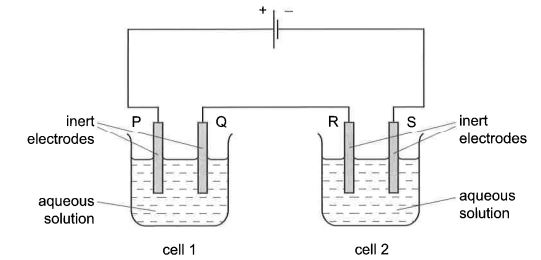
Answer: B. The two cells are in series, so the same current (and the same number of moles of electrons) passes through both in the same time. This makes statement C impossible.
Cathodes Q and S gain mass with no gas, so a metal is deposited at each. Because the same charge passes through both cells but the masses deposited differ, the metals must be different, so the two solutions contain different cations. That is statement B.
Statement A is wrong: for a given charge the mass deposited depends on the metal, not on concentration. Statement D is wrong: all four electrodes are inert platinum, so the anodes P and R lose no mass at all (oxygen is released there). Answer B.
Get the Sec 3 / Sec 4 recording package
Every O Level Pure Chemistry TYS MCQ solution video, plus full Sec 3 / Sec 4 topic recordings.
Find out more