2025 H2 Chem P1 Q9 — Kinetics Solution
Question
What change in conditions would result in the changes from J to K?
Video Solution
Explanation
The answer is C (adding a catalyst and decreasing the temperature).
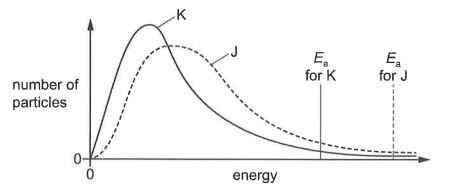
• Temperature: curve K has a higher peak that lies further to the left than curve J, and a smaller tail at high energy. The spread of energies is narrower and the most probable energy is lower, so K is at a lower temperature than J: the temperature was decreased.
• Catalyst: \(E_\text{a}\) for K is lower than \(E_\text{a}\) for J. Temperature does not change the activation energy, so a catalyst (providing an alternative pathway of lower \(E_\text{a}\)) must have been added.
• A is wrong: an increase in temperature would make the curve flatter and shift its peak to the right, and would not lower \(E_\text{a}\).
• B is wrong: a decrease in temperature alone explains the change in the curve but not the lower \(E_\text{a}\).
• D is wrong: a catalyst is added, but the temperature has decreased, not increased.
Want Mr Khemistry to teach you this?
Join a live JC H2 Chemistry class at Bukit Timah, Tampines, or online. Come for a trial lesson, no obligation.
Book a trial classPractice this topic
20+ more Kinetics questions with shuffled options in ChemBank, free for everyone. Want more? The ChemBank Premium ($100/month) unlocks 4,000+ TYS and Prelim questions, Paper 2 & 3 practice with worked solutions, and all simulations.
Open ChemBank free