2025 H2 Chem P1 Q8 — Thermodynamics Solution
Question
The overall process is summarised by the following equation.
\(2\text{H}_2\text{(g)} + \text{O}_2\text{(g)} \rightarrow 2\text{H}_2\text{O(l)}\)
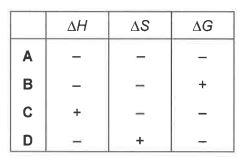
Which row correctly shows the signs for \(\Delta H\), \(\Delta S\) and \(\Delta G\) for this process in the hydrogen–oxygen fuel cell at room temperature?
Video Solution
Explanation
The answer is A (\(\Delta H\) negative, \(\Delta S\) negative, \(\Delta G\) negative).
• \(\Delta H\): forming water from hydrogen and oxygen (the same overall reaction as burning hydrogen) is strongly exothermic, so \(\Delta H\) is negative.
• \(\Delta S\): 3 mol of gas (2 mol \(\text{H}_2\) + 1 mol \(\text{O}_2\)) become 2 mol of liquid water. The number of ways of arranging the particles and their energy decreases, so \(\Delta S\) is negative.
• \(\Delta G\): the reaction in the fuel cell takes place spontaneously and does useful electrical work, so \(\Delta G\) is negative. At room temperature the large negative \(\Delta H\) outweighs the \(-T\Delta S\) term, which is positive.
• B is wrong: \(\Delta G\) is not positive, because the cell reaction is spontaneous.
• C is wrong: \(\Delta H\) is not positive, because forming water from hydrogen and oxygen is exothermic.
• D is wrong: \(\Delta S\) is not positive, because gases are converted into a smaller amount of liquid.
Want Mr Khemistry to teach you this?
Join a live JC H2 Chemistry class at Bukit Timah, Tampines, or online. Come for a trial lesson, no obligation.
Book a trial classPractice this topic
20+ more Thermodynamics questions with shuffled options in ChemBank, free for everyone. Want more? The ChemBank Premium ($100/month) unlocks 4,000+ TYS and Prelim questions, Paper 2 & 3 practice with worked solutions, and all simulations.
Open ChemBank free