2025 H2 Chem P1 Q5 — Periodic table Solution
Question
Which statement best describes the nature of the aqueous solutions of L and M?
Video Solution
Explanation
The answer is C (L neutral, M acidic).
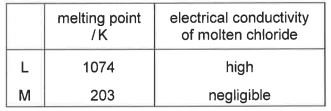
• L: its chloride has a very high melting point (1074 K) and conducts electricity when molten, so it has mobile ions and a giant ionic structure. L is NaCl or \(\text{MgCl}_2\). NaCl dissolves to give a neutral solution; \(\text{MgCl}_2\) gives only a very slightly acidic solution (pH about 6.5), so the solution of L is taken as neutral.
• M: its chloride has a low melting point (203 K) and negligible conductivity when molten, so it is a simple covalent molecule, e.g. \(\text{PCl}_5\). It is hydrolysed by water to give an acidic solution: \(\text{PCl}_5 + 4\text{H}_2\text{O} \rightarrow \text{H}_3\text{PO}_4 + 5\text{HCl}\).
• A is wrong: the solution of M is acidic, not neutral.
• B is wrong: neither solution is alkaline; no Period 3 chloride gives an alkaline solution.
• D is wrong: L is not alkaline and M is not neutral.
Want Mr Khemistry to teach you this?
Join a live JC H2 Chemistry class at Bukit Timah, Tampines, or online. Come for a trial lesson, no obligation.
Book a trial classPractice this topic
20+ more Periodic table questions with shuffled options in ChemBank, free for everyone. Want more? The ChemBank Premium ($100/month) unlocks 4,000+ TYS and Prelim questions, Paper 2 & 3 practice with worked solutions, and all simulations.
Open ChemBank free