2025 H2 Chem P1 Q30 — Transition elements Solution
Question
Element M has a proton number between 22 and 29.
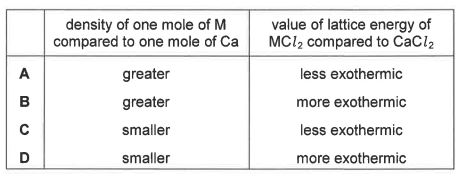
Which row is correct?
Video Solution
Explanation
The answer is B (density greater; lattice energy of \(\text{MCl}_2\) more exothermic).
M is a Period 4 transition element.
• Density: from the Data Booklet, the atomic radius of M (for example Ni, 0.124 nm) is much smaller than that of Ca (0.197 nm), so each atom of M occupies a smaller volume, while the mass of an atom of M (\(A_\text{r}\) 47.9 or more, from Ti to Cu) is larger than that of Ca (40.1). Greater mass in a smaller volume means M has the greater density.
• Lattice energy: the ionic radius of \(\text{M}^{2+}\) (for example \(\text{Fe}^{2+}\), 0.061 nm) is smaller than that of \(\text{Ca}^{2+}\) (0.099 nm), while the ionic charges and the anion (\(\text{Cl}^-\)) are the same. Since lattice energy \(\propto -\left|\dfrac{q_+ q_-}{r_+ + r_-}\right|\), the lattice energy of \(\text{MCl}_2\) is more exothermic than that of \(\text{CaCl}_2\).
• A is wrong: the lattice energy of \(\text{MCl}_2\) is more exothermic, not less, because \(\text{M}^{2+}\) is smaller.
• C is wrong: M is denser than Ca, and its lattice energy is more exothermic.
• D is wrong: M is denser than Ca, not less dense.
Want Mr Khemistry to teach you this?
Join a live JC H2 Chemistry class at Bukit Timah, Tampines, or online. Come for a trial lesson, no obligation.
Book a trial classPractice this topic
20+ more Transition elements questions with shuffled options in ChemBank, free for everyone. Want more? The ChemBank Premium ($100/month) unlocks 4,000+ TYS and Prelim questions, Paper 2 & 3 practice with worked solutions, and all simulations.
Open ChemBank free