2025 H2 Chem P1 Q26 — Electrochemical cell Solution
Question
The following cell was set up under standard conditions. The cell contains a silver half-cell, \(\text{Ag}^+\text{(aq)}/\text{Ag(s)}\), and a chlorine half-cell, \(Cl_2\text{(g)}/Cl^-\text{(aq)}\).
A 0.1 mol dm\(^{-3}\) solution of sodium chloride was then added to the silver half-cell.
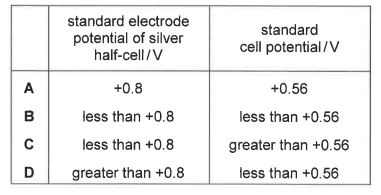
What are the effects on the standard electrode potential of the silver half-cell and the standard cell potential?
Video Solution
Explanation
The answer is C (silver half-cell less than +0.8 V; cell potential greater than +0.56 V).
From the Data Booklet: \(E^\ominus(\text{Cl}_2/\text{Cl}^-) = +1.36\) V and \(E^\ominus(\text{Ag}^+/\text{Ag}) = +0.80\) V. The chlorine half-cell is the positive electrode (reduction) and the silver half-cell is the negative electrode (oxidation):
\(E_\text{cell} = E(\text{positive electrode}) - E(\text{negative electrode}) = +1.36 - (+0.80) = +0.56\) V
Adding NaCl(aq) to the silver half-cell precipitates silver chloride: \(\text{Ag}^+\text{(aq)} + \text{Cl}^-\text{(aq)} \rightarrow \text{AgCl(s)}\). \([\text{Ag}^+]\) falls, so the equilibrium \(\text{Ag}^+ + \text{e}^- \rightleftharpoons \text{Ag}\) shifts to the left. Reduction of \(\text{Ag}^+\) becomes less favourable, so the electrode potential of the silver half-cell becomes less than +0.80 V.
The silver half-cell is the negative electrode, so a less positive \(E(\text{Ag}^+/\text{Ag})\) is subtracted in \(E_\text{cell} = E(\text{Cl}_2/\text{Cl}^-) - E(\text{Ag}^+/\text{Ag})\), making \(E_\text{cell}\) greater than +0.56 V.
• A is wrong: removing \(\text{Ag}^+\) does change the potential of the silver half-cell, so neither value stays the same.
• B is wrong: the silver potential does fall, but because silver is the negative electrode this increases the cell potential, not decreases it.
• D is wrong: lowering \([\text{Ag}^+]\) makes the silver potential less positive, not greater than +0.8 V, and the cell potential increases.
Want Mr Khemistry to teach you this?
Join a live JC H2 Chemistry class at Bukit Timah, Tampines, or online. Come for a trial lesson, no obligation.
Book a trial classPractice this topic
20+ more Electrochemical cell questions with shuffled options in ChemBank, free for everyone. Want more? The ChemBank Premium ($100/month) unlocks 4,000+ TYS and Prelim questions, Paper 2 & 3 practice with worked solutions, and all simulations.
Open ChemBank free