2025 H2 Chem P1 Q25 — Nitrogen Compound Solution
Question
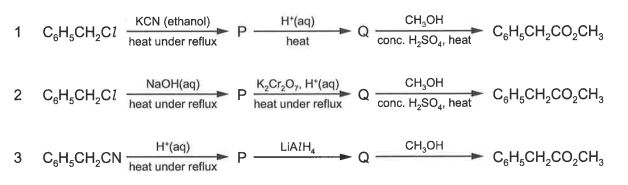
Three routes are proposed. The intermediates P and Q are not necessarily the same in each route.
Which routes will be successful?
Video Solution
Explanation
The answer is C (1 only).
• Route 1 succeeds: \(\text{C}_6\text{H}_5\text{CH}_2\text{Cl}\) with KCN in ethanol undergoes nucleophilic substitution to give P, \(\text{C}_6\text{H}_5\text{CH}_2\text{CN}\) (one extra carbon). Acid hydrolysis gives Q, \(\text{C}_6\text{H}_5\text{CH}_2\text{CO}_2\text{H}\). Heating Q with \(\text{CH}_3\text{OH}\) and concentrated \(\text{H}_2\text{SO}_4\) gives the ester \(\text{C}_6\text{H}_5\text{CH}_2\text{CO}_2\text{CH}_3\).
• Route 2 fails: NaOH(aq) gives P, \(\text{C}_6\text{H}_5\text{CH}_2\text{OH}\), and acidified \(\text{K}_2\text{Cr}_2\text{O}_7\) oxidises it to Q, benzoic acid \(\text{C}_6\text{H}_5\text{CO}_2\text{H}\). No carbon is added, so esterification gives \(\text{C}_6\text{H}_5\text{CO}_2\text{CH}_3\), one \(\text{CH}_2\) short of the target.
• Route 3 fails: acid hydrolysis gives P, \(\text{C}_6\text{H}_5\text{CH}_2\text{CO}_2\text{H}\), but \(\text{LiAlH}_4\) then reduces it to Q, the alcohol \(\text{C}_6\text{H}_5\text{CH}_2\text{CH}_2\text{OH}\). An alcohol does not react with \(\text{CH}_3\text{OH}\) to form an ester, so the target is not made.
• A is wrong: it includes routes 2 and 3.
• B is wrong: it includes route 2.
• D is wrong: it includes routes 2 and 3 and leaves out route 1.
Want Mr Khemistry to teach you this?
Join a live JC H2 Chemistry class at Bukit Timah, Tampines, or online. Come for a trial lesson, no obligation.
Book a trial classPractice this topic
20+ more Nitrogen Compound questions with shuffled options in ChemBank, free for everyone. Want more? The ChemBank Premium ($100/month) unlocks 4,000+ TYS and Prelim questions, Paper 2 & 3 practice with worked solutions, and all simulations.
Open ChemBank free