2025 H2 Chem P1 Q24 — Nitrogen Compound Solution
Question
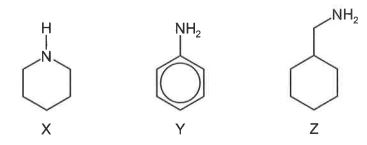
In which order do the base strengths of X, Y and Z increase?
Video Solution
Explanation
The answer is B (Y \(\rightarrow\) Z \(\rightarrow\) X).
Base strength depends on how available the lone pair on N is for donation to a Lewis acid. In the gaseous state there is no solvation, so only electronic effects matter.
• Y (phenylamine): the lone pair on N is delocalised into the benzene ring, so it is the least available. Y is the weakest base.
• Z (cyclohexylmethanamine, a primary amine): one electron-donating alkyl group on N increases the electron density on N.
• X (piperidine, a secondary amine): two electron-donating alkyl groups on N, so its lone pair is the most available. X is the strongest base.
Base strength increases: Y \(<\) Z \(<\) X.
• A is wrong: it places Z (one alkyl group) above X (two alkyl groups).
• C is wrong: it makes Y the strongest base, but its lone pair is delocalised into the ring.
• D is wrong: it places Y above Z, but Z has an electron-donating alkyl group while the lone pair of Y is delocalised.
Want Mr Khemistry to teach you this?
Join a live JC H2 Chemistry class at Bukit Timah, Tampines, or online. Come for a trial lesson, no obligation.
Book a trial classPractice this topic
20+ more Nitrogen Compound questions with shuffled options in ChemBank, free for everyone. Want more? The ChemBank Premium ($100/month) unlocks 4,000+ TYS and Prelim questions, Paper 2 & 3 practice with worked solutions, and all simulations.
Open ChemBank free