2025 H2 Chem P1 Q21 — Carboxylic Acid Solution
Question
what could ester J be?
1) \(\text{CH}_3\text{CO}_2\text{C}_2\text{H}_5\)
2) \(\text{CH}_3\text{CH}_2\text{CO}_2\text{CH(CH}_3)_2\)
3) \(\text{CH}_3\text{CH}_2\text{CH}_2\text{CO}_2\text{CH}_2\text{CH}_3\)
Video Solution
Explanation
The answer is B (1 only).
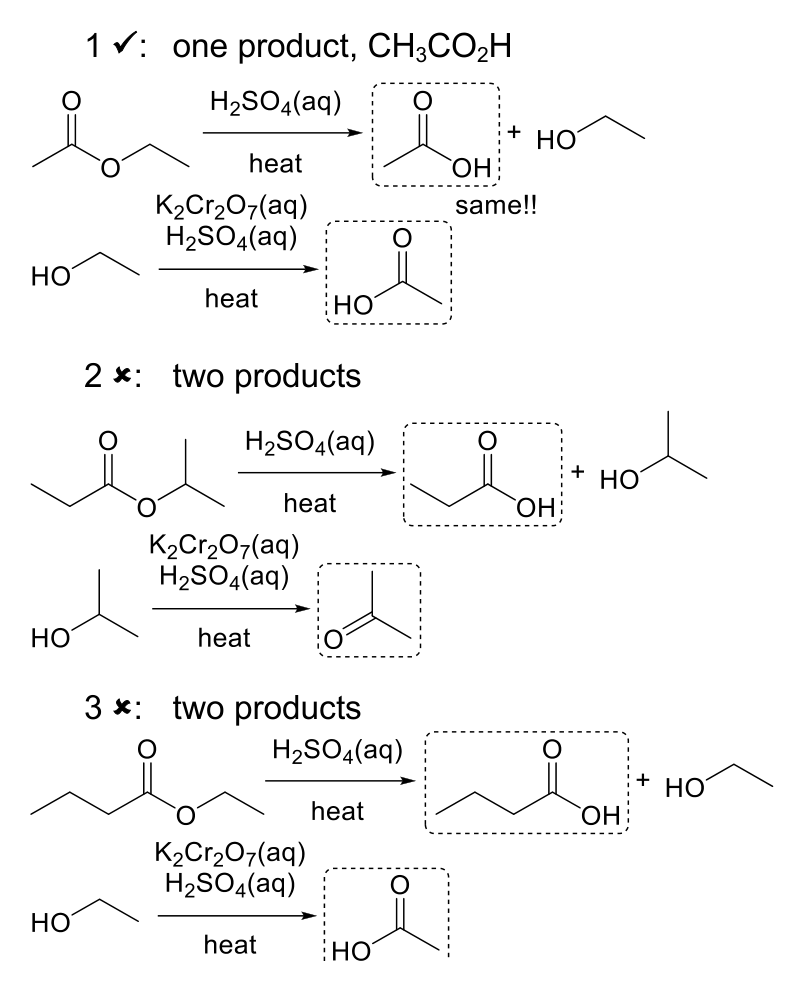
Acid hydrolysis splits each ester into a carboxylic acid and an alcohol. Heating under reflux with acidified \(\text{K}_2\text{Cr}_2\text{O}_7\) then oxidises the alcohol (a primary alcohol to a carboxylic acid, a secondary alcohol to a ketone). Only one organic compound remains if the oxidised alcohol gives the same compound as the acid.
• 1: \(\text{CH}_3\text{CO}_2\text{C}_2\text{H}_5\) gives \(\text{CH}_3\text{CO}_2\text{H}\) and \(\text{C}_2\text{H}_5\text{OH}\); ethanol is oxidised to \(\text{CH}_3\text{CO}_2\text{H}\). The only product is ethanoic acid, so 1 is correct.
• 2: \(\text{CH}_3\text{CH}_2\text{CO}_2\text{CH(CH}_3)_2\) gives \(\text{CH}_3\text{CH}_2\text{CO}_2\text{H}\) and propan-2-ol; propan-2-ol is oxidised to propanone, \(\text{CH}_3\text{COCH}_3\). Two products (propanoic acid and propanone), so 2 is wrong.
• 3: \(\text{CH}_3\text{CH}_2\text{CH}_2\text{CO}_2\text{CH}_2\text{CH}_3\) gives \(\text{CH}_3\text{CH}_2\text{CH}_2\text{CO}_2\text{H}\) and ethanol; ethanol is oxidised to \(\text{CH}_3\text{CO}_2\text{H}\). Two products (butanoic acid and ethanoic acid), so 3 is wrong.
• A, C and D are wrong because they include 2 or 3, or leave out 1.
Want Mr Khemistry to teach you this?
Join a live JC H2 Chemistry class at Bukit Timah, Tampines, or online. Come for a trial lesson, no obligation.
Book a trial classPractice this topic
20+ more Carboxylic Acid questions with shuffled options in ChemBank, free for everyone. Want more? The ChemBank Premium ($100/month) unlocks 4,000+ TYS and Prelim questions, Paper 2 & 3 practice with worked solutions, and all simulations.
Open ChemBank free