2025 H2 Chem P1 Q15 — Introduction to Organic Solution
Question
Compound P contains only one functional group, which can be a carboxylic acid or an ester.
How many constitutional (structural) isomers are possible for compound P?
Video Solution
Explanation
The answer is D (6).
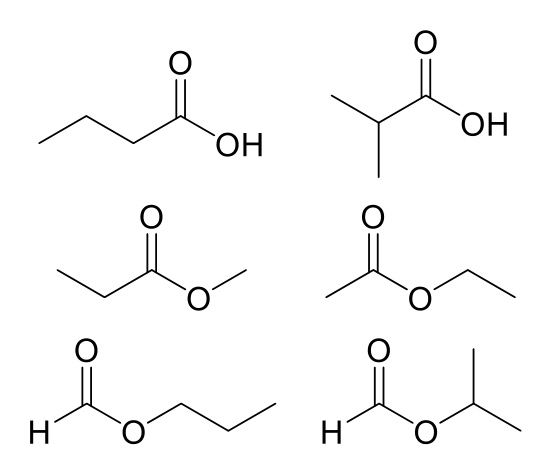
\(\text{C}_4\text{H}_8\text{O}_2\) has one C=O and no rings. The six constitutional isomers are:
• Carboxylic acids (2): butanoic acid, \(\text{CH}_3\text{CH}_2\text{CH}_2\text{CO}_2\text{H}\), and 2-methylpropanoic acid, \((\text{CH}_3)_2\text{CHCO}_2\text{H}\).
• Esters (4): methyl propanoate, \(\text{CH}_3\text{CH}_2\text{CO}_2\text{CH}_3\); ethyl ethanoate, \(\text{CH}_3\text{CO}_2\text{CH}_2\text{CH}_3\); propyl methanoate, \(\text{HCO}_2\text{CH}_2\text{CH}_2\text{CH}_3\); and 1-methylethyl methanoate, \(\text{HCO}_2\text{CH(CH}_3)_2\).
Total = 2 + 4 = 6.
• A is wrong: 2 counts only the carboxylic acids.
• B is wrong: 4 counts only the esters.
• C is wrong: 5 misses one of the six isomers, for example one of the two branched structures (2-methylpropanoic acid or 1-methylethyl methanoate).
Want Mr Khemistry to teach you this?
Join a live JC H2 Chemistry class at Bukit Timah, Tampines, or online. Come for a trial lesson, no obligation.
Book a trial classPractice this topic
20+ more Introduction to Organic questions with shuffled options in ChemBank, free for everyone. Want more? The ChemBank Premium ($100/month) unlocks 4,000+ TYS and Prelim questions, Paper 2 & 3 practice with worked solutions, and all simulations.
Open ChemBank free