2025 H2 Chem P1 Q14 — Alkene Solution
Question
Video Solution
Explanation
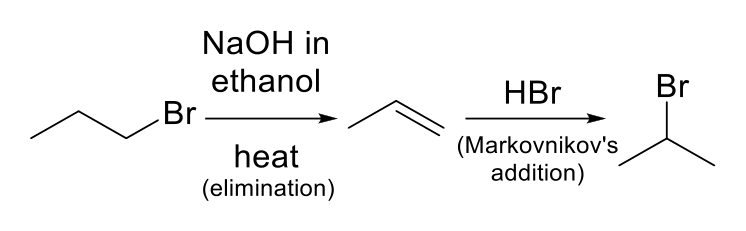
The answer is C (elimination followed by addition).
• Stage 1, elimination: heating 1-bromopropane with NaOH in ethanol removes HBr to give propene, \(\text{CH}_3\text{CH}_2\text{CH}_2\text{Br} + \text{OH}^- \rightarrow \text{CH}_3\text{CH=CH}_2 + \text{H}_2\text{O} + \text{Br}^-\).
• Stage 2, electrophilic addition: propene reacts with HBr. By Markovnikov's rule the H adds to the terminal carbon (the carbon that already has more H atoms), through the more stable secondary carbocation, so Br ends up on the middle carbon: \(\text{CH}_3\text{CH=CH}_2 + \text{HBr} \rightarrow \text{CH}_3\text{CHBrCH}_3\).
This moves the Br from a primary carbon to a secondary carbon.
• A is wrong: substitution first gives propan-1-ol, and elimination of water from it gives propene, not a bromoalkane.
• B is wrong: 1-bromopropane is saturated, so it cannot undergo addition as the first stage.
• D is wrong: after elimination the product is propene, which needs addition of HBr (across the C=C bond), not substitution, to form 2-bromopropane.
Want Mr Khemistry to teach you this?
Join a live JC H2 Chemistry class at Bukit Timah, Tampines, or online. Come for a trial lesson, no obligation.
Book a trial classPractice this topic
20+ more Alkene questions with shuffled options in ChemBank, free for everyone. Want more? The ChemBank Premium ($100/month) unlocks 4,000+ TYS and Prelim questions, Paper 2 & 3 practice with worked solutions, and all simulations.
Open ChemBank free