2025 H2 Chem P1 Q11 — Thermodynamics Solution
Question
\(\text{H}_2\text{O(g)} + \text{CO(g)} \rightleftharpoons \text{H}_2\text{(g)} + \text{CO}_2\text{(g)}\)
Equimolar amounts of \(\text{H}_2\text{O}\) and CO were introduced into a sealed container and allowed to reach equilibrium.
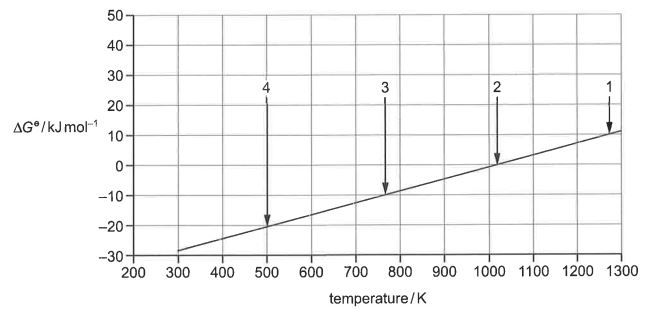
At which points will the concentration of \(\text{H}_2\) be greater than the concentration of \(\text{H}_2\text{O}\) at equilibrium?
Video Solution
Explanation
The answer is D (3 and 4 only).
The reaction is 1 : 1 : 1 : 1 and equimolar \(\text{H}_2\text{O}\) and CO are used, so at equilibrium \([\text{H}_2] = [\text{CO}_2]\) and \([\text{H}_2\text{O}] = [\text{CO}]\). Therefore
\(K = \dfrac{[\text{H}_2][\text{CO}_2]}{[\text{H}_2\text{O}][\text{CO}]} = \dfrac{[\text{H}_2]^2}{[\text{H}_2\text{O}]^2}\)
\([\text{H}_2] > [\text{H}_2\text{O}]\) requires \(K > 1\), and since \(\Delta G^{\ominus} = -RT\ln K\), \(K > 1\) means \(\Delta G^{\ominus} < 0\).
From the graph, \(\Delta G^{\ominus}\) is negative at points 3 and 4 only.
• A and B are wrong: at point 1, \(\Delta G^{\ominus} > 0\), so \(K < 1\) and \([\text{H}_2] < [\text{H}_2\text{O}]\).
• A and C are wrong: at point 2, \(\Delta G^{\ominus} = 0\), so \(K = 1\) and \([\text{H}_2] = [\text{H}_2\text{O}]\), not greater.
Want Mr Khemistry to teach you this?
Join a live JC H2 Chemistry class at Bukit Timah, Tampines, or online. Come for a trial lesson, no obligation.
Book a trial classPractice this topic
20+ more Thermodynamics questions with shuffled options in ChemBank, free for everyone. Want more? The ChemBank Premium ($100/month) unlocks 4,000+ TYS and Prelim questions, Paper 2 & 3 practice with worked solutions, and all simulations.
Open ChemBank free