2025 H2 Chem P1 Q1 — Atomic structure Solution
Question
Which pair represents atoms of two different elements?
Video Solution
Explanation
The answer is D (X and Z).
Proton number = nucleon number minus number of neutrons. A particle is a neutral atom only if its number of electrons equals its proton number.
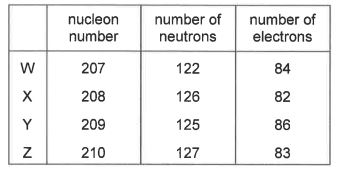
• W: 207 \(-\) 122 = 85 protons, 84 electrons, so W is a +1 cation.
• X: 208 \(-\) 126 = 82 protons, 82 electrons, so X is a neutral atom.
• Y: 209 \(-\) 125 = 84 protons, 86 electrons, so Y is a \(2-\) anion.
• Z: 210 \(-\) 127 = 83 protons, 83 electrons, so Z is a neutral atom.
X (82 protons) and Z (83 protons) are both atoms, and they have different proton numbers, so they are atoms of two different elements.
• A is wrong: W and Y are both ions, not atoms.
• B is wrong: W is a +1 ion, not an atom.
• C is wrong: Y is a \(2-\) ion, not an atom.
Want Mr Khemistry to teach you this?
Join a live JC H2 Chemistry class at Bukit Timah, Tampines, or online. Come for a trial lesson, no obligation.
Book a trial classPractice this topic
20+ more Atomic structure questions with shuffled options in ChemBank, free for everyone. Want more? The ChemBank Premium ($100/month) unlocks 4,000+ TYS and Prelim questions, Paper 2 & 3 practice with worked solutions, and all simulations.
Open ChemBank free