2024 H2 Chem P1 Q29 — Transition elements Solution
Question
The 3d orbitals of the transition metal ions shown are split into two different energy levels in their octahedral complexes.
Assume the electrons occupy all the 3d orbitals singly before pairing up.
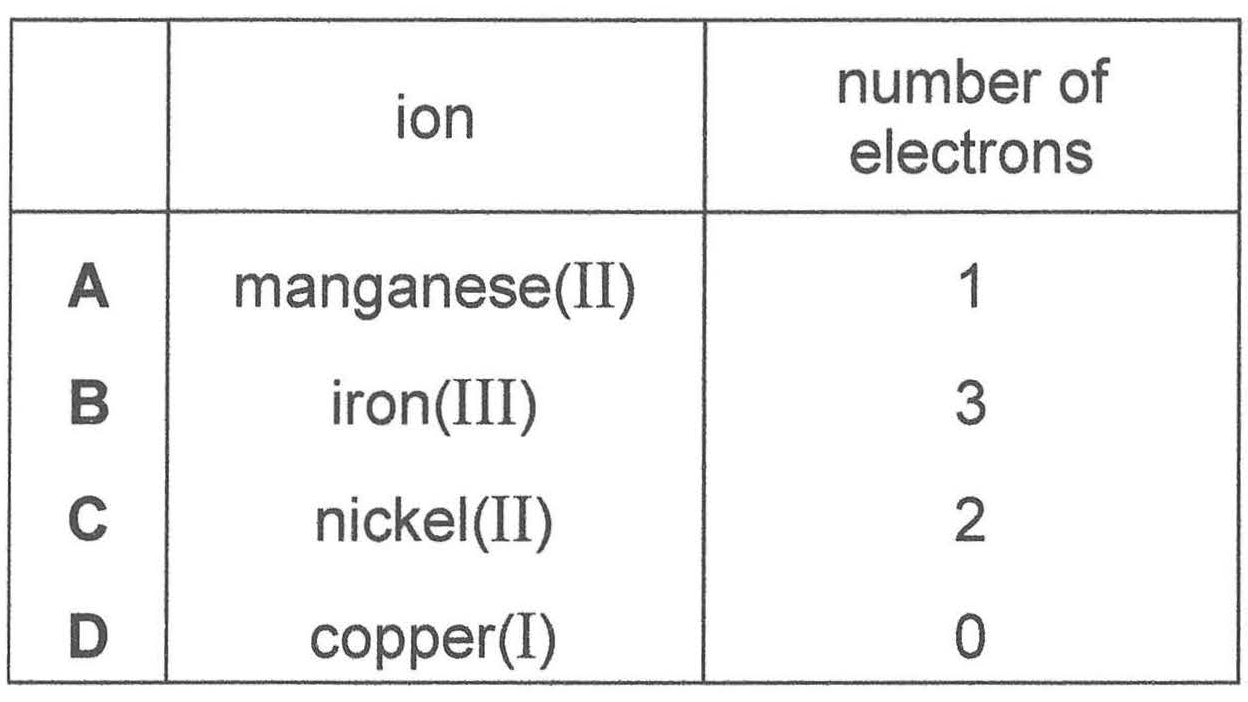
Which row shows the number of electrons in the higher energy 3d orbitals when this splitting occurs?
Video Solution
Explanation
The answer is C (nickel(II), 2).
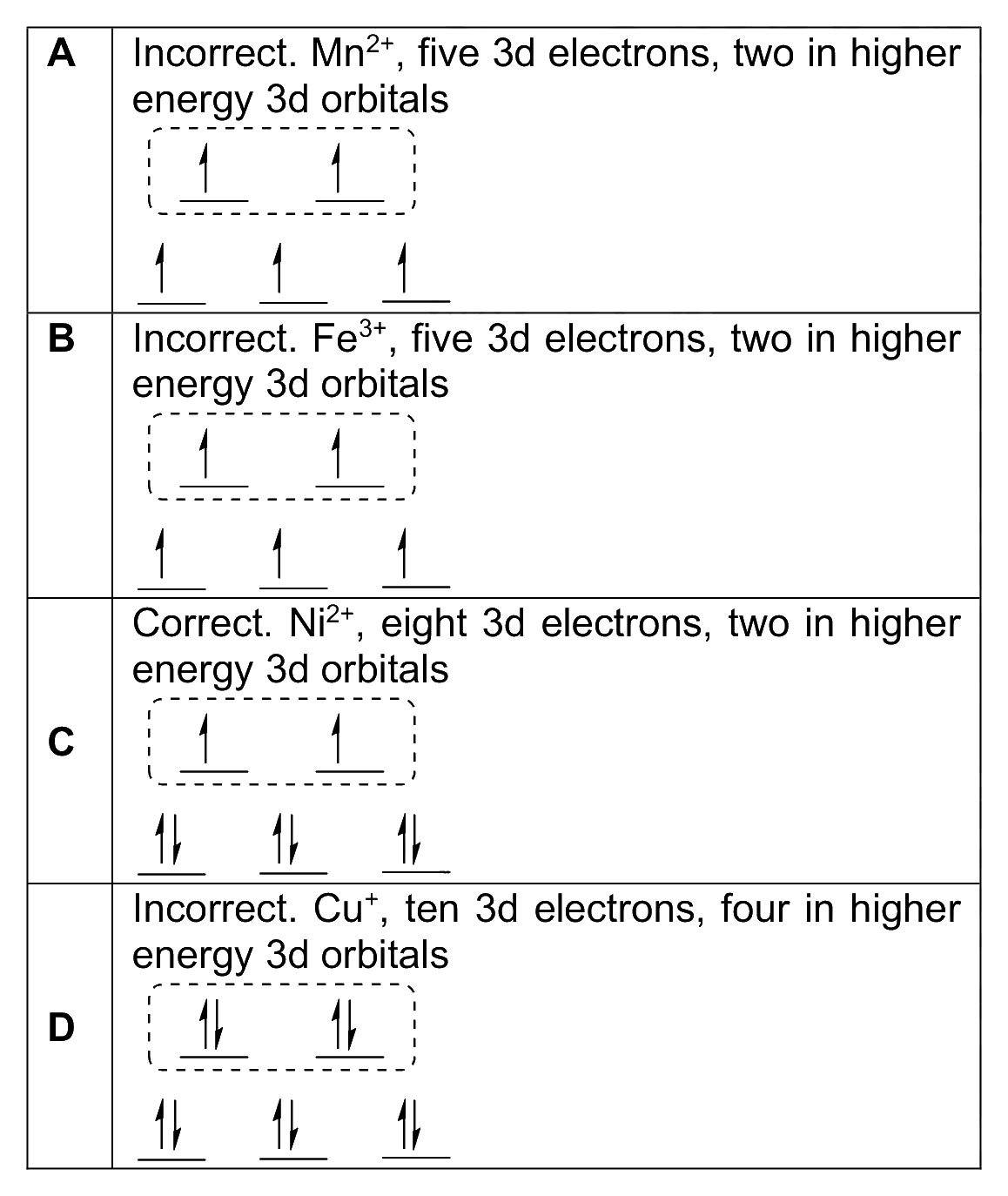
In an octahedral complex the five 3d orbitals split into three lower-energy orbitals and two higher-energy orbitals. Filling each orbital singly before pairing (as the question states), the first 5 electrons go one into each of the five orbitals (3 lower, 2 higher); electrons 6, 7 and 8 then pair up in the three lower orbitals, and electrons 9 and 10 pair up in the two higher orbitals.
Nickel(II): Ni is [Ar]\(3\text{d}^8 4\text{s}^2\), so \(\text{Ni}^{2+}\) is [Ar]\(3\text{d}^8\). Six electrons fill the three lower orbitals (paired) and 2 go singly into the higher orbitals, as shown in the explanation figure. The row value 2 is correct.
• A is wrong: Mn is [Ar]\(3\text{d}^5 4\text{s}^2\), so \(\text{Mn}^{2+}\) is \(3\text{d}^5\): 3 electrons in the lower orbitals and 2 in the higher orbitals, not 1.
• B is wrong: Fe is [Ar]\(3\text{d}^6 4\text{s}^2\), so \(\text{Fe}^{3+}\) is \(3\text{d}^5\): again 2 electrons in the higher orbitals, not 3.
• D is wrong: Cu is [Ar]\(3\text{d}^{10} 4\text{s}^1\), so \(\text{Cu}^+\) is \(3\text{d}^{10}\): all five orbitals are full, so 4 electrons are in the higher orbitals, not 0.
Want Mr Khemistry to teach you this?
Join a live JC H2 Chemistry class at Bukit Timah, Tampines, or online. Come for a trial lesson, no obligation.
Book a trial classPractice this topic
20+ more Transition elements questions with shuffled options in ChemBank, free for everyone. Want more? The ChemBank Premium ($100/month) unlocks 4,000+ TYS and Prelim questions, Paper 2 & 3 practice with worked solutions, and all simulations.
Open ChemBank free