2024 H2 Chem P1 Q22 — Hydroxyl Compounds Solution
Question
Video Solution
Explanation
The answer is D.
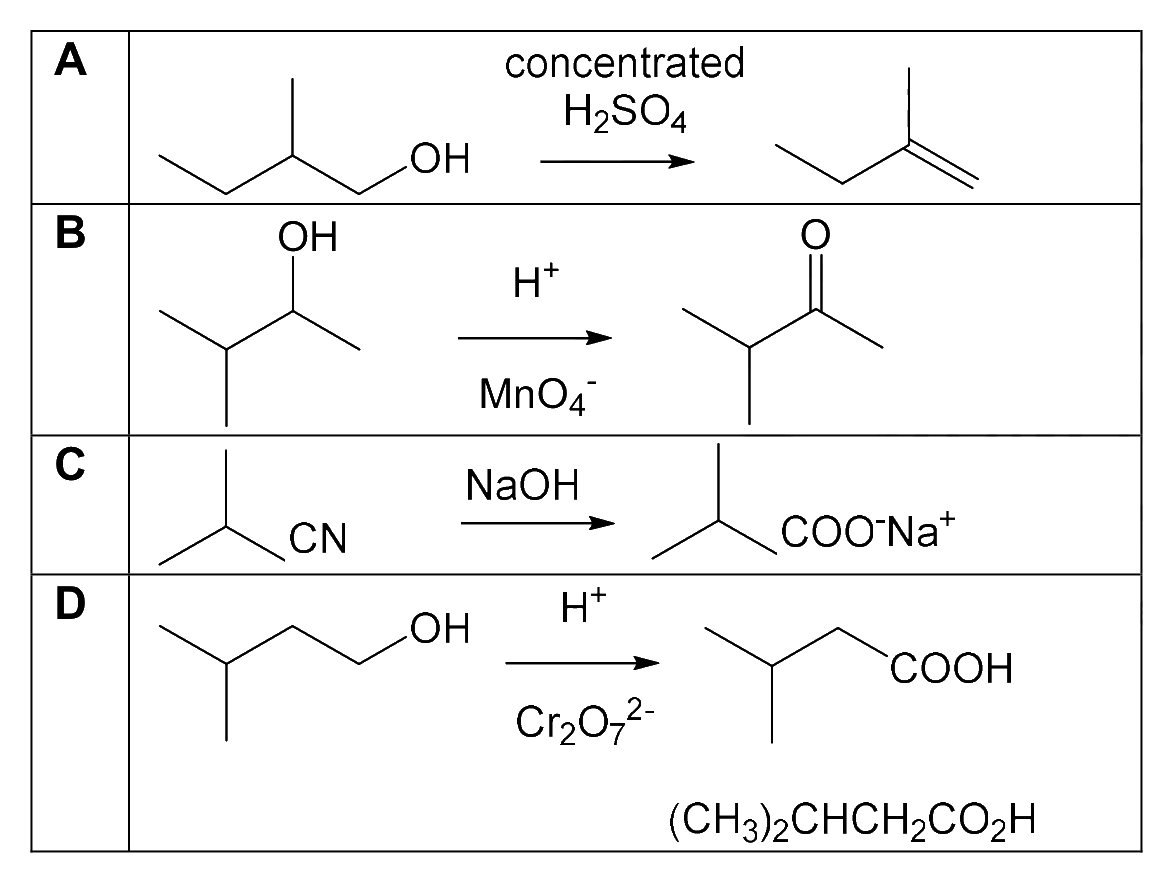
The target, \((\text{CH}_3)_2\text{CHCH}_2\text{CO}_2\text{H}\), is 3-methylbutanoic acid, with 5 carbon atoms.
• D is correct: 3-methylbutan-1-ol, \((\text{CH}_3)_2\text{CHCH}_2\text{CH}_2\text{OH}\), is a primary alcohol. Heating with acidified \(\text{Cr}_2\text{O}_7^{2-}\) oxidises it to the carboxylic acid \((\text{CH}_3)_2\text{CHCH}_2\text{CO}_2\text{H}\).
• A is wrong: concentrated \(\text{H}_2\text{SO}_4\) dehydrates 2-methylbutan-1-ol to an alkene, 2-methylbut-1-ene, not an acid.
• B is wrong: 3-methylbutan-2-ol is a secondary alcohol, so acidified \(\text{MnO}_4^-\) oxidises it to a ketone, 3-methylbutan-2-one.
• C is wrong: 2-methylpropanenitrile, \((\text{CH}_3)_2\text{CHCN}\), has only 4 carbon atoms. Hydrolysis with sodium hydroxide gives the salt sodium 2-methylpropanoate, \((\text{CH}_3)_2\text{CHCO}_2^-\text{Na}^+\) (and \(\text{NH}_3\)): it has one carbon too few and is a carboxylate salt, not the acid.
Want Mr Khemistry to teach you this?
Join a live JC H2 Chemistry class at Bukit Timah, Tampines, or online. Come for a trial lesson, no obligation.
Book a trial classPractice this topic
20+ more Hydroxyl Compounds questions with shuffled options in ChemBank, free for everyone. Want more? The ChemBank Premium ($100/month) unlocks 4,000+ TYS and Prelim questions, Paper 2 & 3 practice with worked solutions, and all simulations.
Open ChemBank free