2024 H2 Chem P1 Q21 — Arene Solution
Question
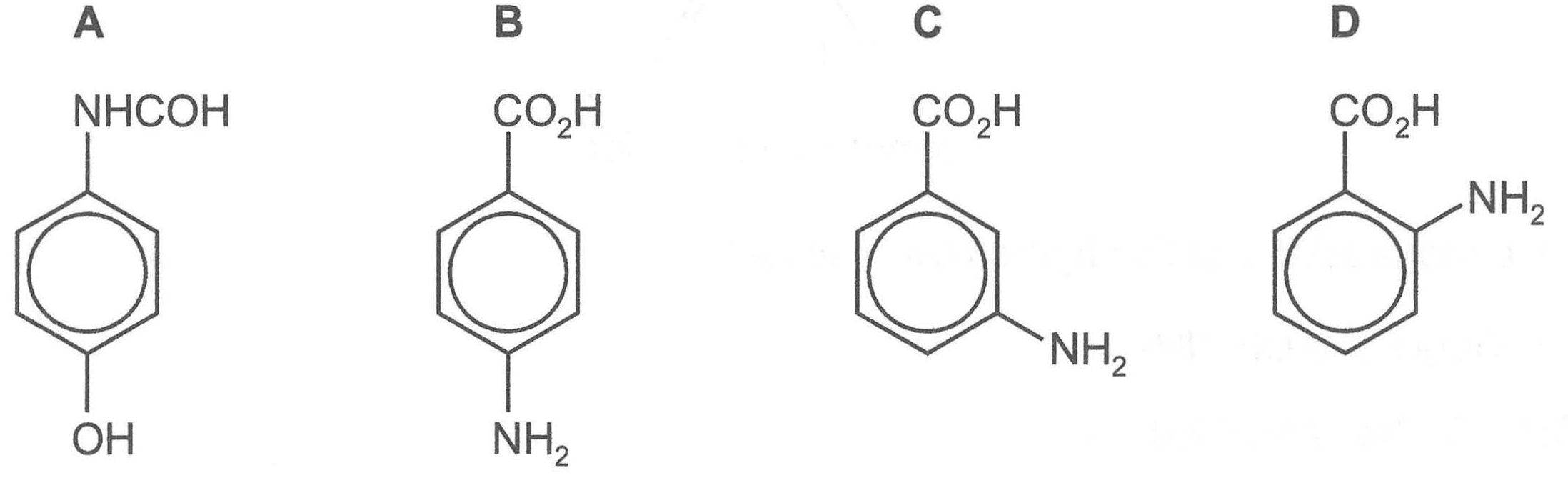
Compound Y, \(C_7H_7NO_2\), reacts with \(Br_2(aq)\) at room temperature to produce \(C_7H_4NO_2Br_3\).
What is the structural formula of Y?
Video Solution
Explanation
The answer is C (3-aminobenzoic acid).
Y (\(\text{C}_7\text{H}_7\text{NO}_2\)) gains 3 Br and loses 3 H to give \(\text{C}_7\text{H}_4\text{NO}_2\text{Br}_3\), so 3 H atoms on the ring are substituted by aqueous bromine at room temperature. This happens only with a strongly activated ring (phenol or phenylamine), which is brominated at the 2-, 4- and 6-positions relative to the \(-\text{OH}\) or \(-\text{NH}_2\) group. So all three of these positions must be free.
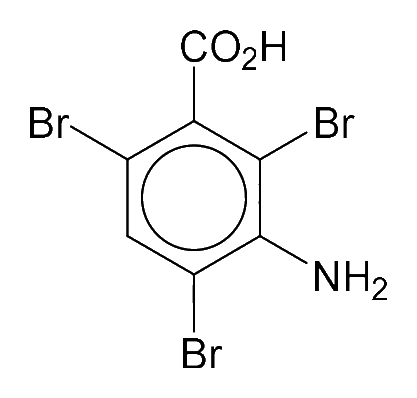
In C, \(-\text{NH}_2\) is at position 3 of benzoic acid. The positions 2, 4 and 6 relative to \(-\text{NH}_2\) are all unoccupied, so three Br atoms substitute, giving 3-amino-2,4,6-tribromobenzoic acid, as shown in the explanation figure.
• A is wrong: the position 4 relative to the \(-\text{OH}\) group is already taken by the \(-\text{NHCHO}\) group, so only the 2- and 6-positions are free and the product would contain only 2 Br (\(\text{C}_7\text{H}_5\text{NO}_2\text{Br}_2\)).
• B is wrong: the position 4 relative to \(-\text{NH}_2\) is occupied by \(-\text{CO}_2\text{H}\), so only 2 Br can substitute (\(\text{C}_7\text{H}_5\text{NO}_2\text{Br}_2\)).
• D is wrong: the position 2 relative to \(-\text{NH}_2\) is occupied by \(-\text{CO}_2\text{H}\), so only the 4- and 6-positions are free and only 2 Br can substitute.
Want Mr Khemistry to teach you this?
Join a live JC H2 Chemistry class at Bukit Timah, Tampines, or online. Come for a trial lesson, no obligation.
Book a trial classPractice this topic
20+ more Arene questions with shuffled options in ChemBank, free for everyone. Want more? The ChemBank Premium ($100/month) unlocks 4,000+ TYS and Prelim questions, Paper 2 & 3 practice with worked solutions, and all simulations.
Open ChemBank free