2024 H2 Chem P1 Q19 — Alkene Solution
Question
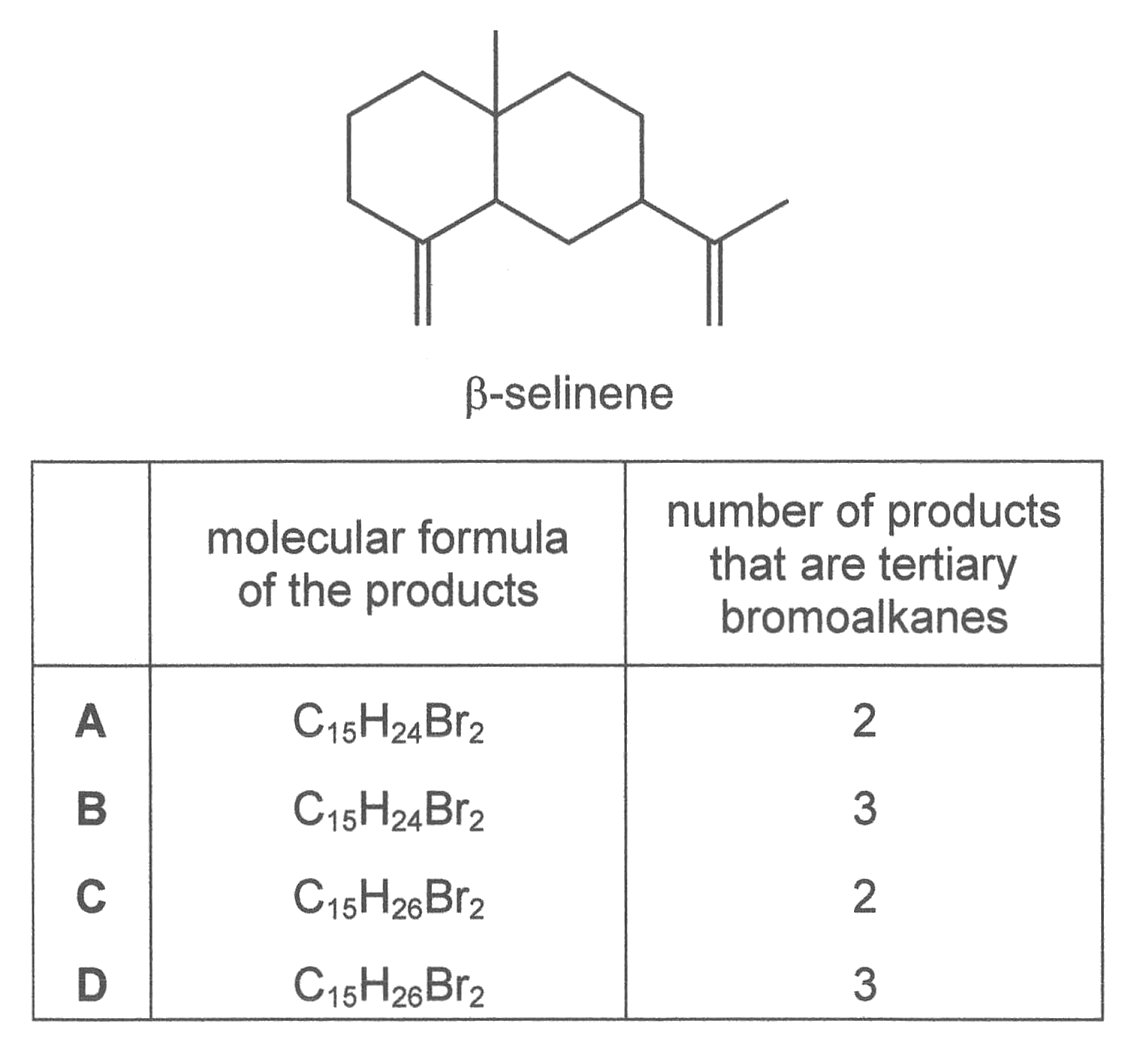
When \(\beta\)-selinene reacts completely with HBr, the product mixture contains different compounds, all with the same molecular formula.
Optical isomers should not be considered when answering this question.
Which row identifies the molecular formula of the products and the number of these products that are tertiary bromoalkanes?
Video Solution
Explanation
The answer is D (\(\text{C}_{15}\text{H}_{26}\text{Br}_2\), 3).
\(\beta\)-selinene has two C=C bonds (the ring \(=\text{CH}_2\) group and the isopropenyl group), so complete reaction adds two HBr:
\(\text{C}_{15}\text{H}_{24} + 2\text{HBr} \rightarrow \text{C}_{15}\text{H}_{26}\text{Br}_2\)
In each C=C, one carbon is a \(=\text{CH}_2\) carbon and the other is bonded to two further carbon atoms. Br can add to either carbon of each C=C:
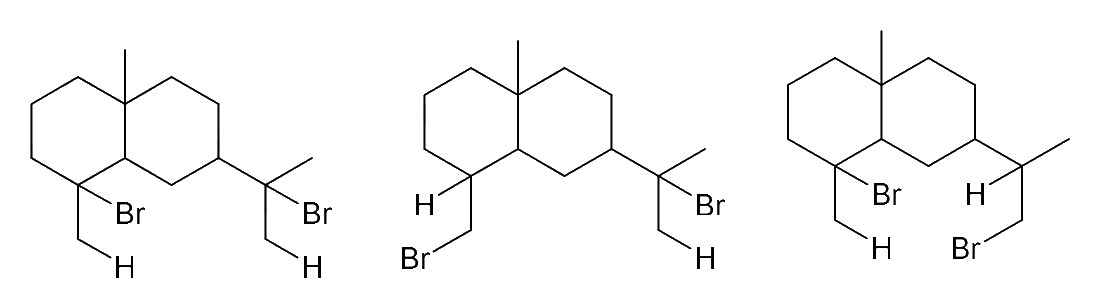
• Br on the more substituted carbon (Markovnikov, via the more stable tertiary carbocation) gives a tertiary C-Br, because that carbon ends up bonded to three carbon atoms.
• Br on the \(\text{CH}_2\) carbon gives a primary C-Br (the minor route).
With two C=C bonds there are four combinations (ignoring optical isomers): tertiary/tertiary, tertiary (ring)/primary, primary/tertiary (side chain) and primary/primary. Three of these contain a tertiary C-Br, as shown in the explanation figure; only the primary/primary product is not a tertiary bromoalkane.
• A and B are wrong: \(\text{C}_{15}\text{H}_{24}\text{Br}_2\) would be the product of adding \(\text{Br}_2\), not HBr. Adding two HBr also adds two H atoms, giving \(\text{C}_{15}\text{H}_{26}\text{Br}_2\).
• C is wrong: the formula is right, but 2 counts only the products with one tertiary C-Br (Br on the ring carbon or on the side-chain carbon) and misses the product in which both C-Br bonds are tertiary.
Want Mr Khemistry to teach you this?
Join a live JC H2 Chemistry class at Bukit Timah, Tampines, or online. Come for a trial lesson, no obligation.
Book a trial classPractice this topic
20+ more Alkene questions with shuffled options in ChemBank, free for everyone. Want more? The ChemBank Premium ($100/month) unlocks 4,000+ TYS and Prelim questions, Paper 2 & 3 practice with worked solutions, and all simulations.
Open ChemBank free