2024 H2 Chem P1 Q18 — Introduction to Organic Solution
Question
3-ethylpentan-3-ol is produced when \(C_2H_5MgBr\) is added to pentan-3-one, followed by the addition of aqueous acid.
Which statement about the behaviour of \(C_2H_5^-\) ions in this reaction is correct?
Video Solution
Explanation
The answer is D.
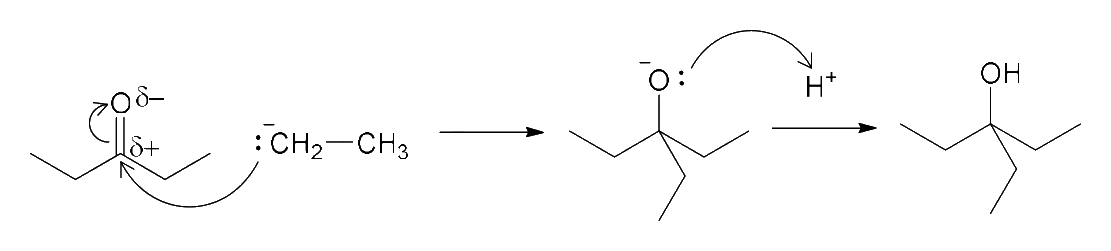
The \(\text{C}_2\text{H}_5^-\) ion uses the lone pair on its carbon to attack the \(\delta+\) carbonyl carbon of pentan-3-one (nucleophilic addition, like the attack of \(\text{CN}^-\) on a carbonyl compound). The alkoxide formed is then protonated by the aqueous acid to give 3-ethylpentan-3-ol. Donating an electron pair makes \(\text{C}_2\text{H}_5^-\) a Lewis base (it acts as a nucleophile).
• A is wrong: an electrophile accepts an electron pair, but \(\text{C}_2\text{H}_5^-\) donates one.
• B is wrong: an Arrhenius base produces \(\text{OH}^-\) ions in water; \(\text{C}_2\text{H}_5^-\) forms no \(\text{OH}^-\) in this reaction.
• C is wrong: a Brønsted-Lowry base accepts \(\text{H}^+\); here \(\text{C}_2\text{H}_5^-\) accepts no proton, it forms a new C-C bond to the carbonyl carbon.
Want Mr Khemistry to teach you this?
Join a live JC H2 Chemistry class at Bukit Timah, Tampines, or online. Come for a trial lesson, no obligation.
Book a trial classPractice this topic
20+ more Introduction to Organic questions with shuffled options in ChemBank, free for everyone. Want more? The ChemBank Premium ($100/month) unlocks 4,000+ TYS and Prelim questions, Paper 2 & 3 practice with worked solutions, and all simulations.
Open ChemBank free