2024 H2 Chem P1 Q16 — Acid base equilibrium Solution
Question
In a titration experiment, 50.0 \(cm^3\) of 0.100 \(mol \, dm^{-3}\) aqueous sodium hydroxide is slowly added to 25.0 \(cm^3\) of 0.150 \(mol \, dm^{-3}\) aqueous ethanoic acid.
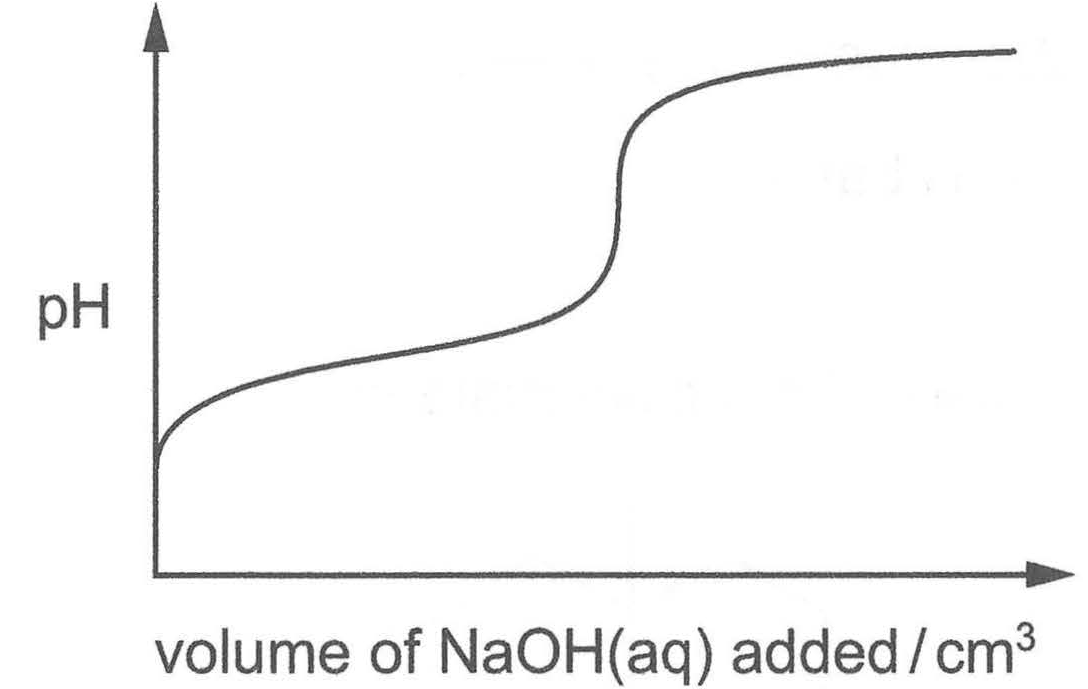
The pH of the reaction mixture is measured throughout the experiment and a graph of pH against volume of aqueous sodium hydroxide added is plotted.
Part of the titration curve is shown.
Consider the two statements.
1) The pH at the end of the experiment will be 13.0.
2) The pH when half of the acid has been neutralised will be the \(pK_a\) of the acid.
Which statements are correct?
Video Solution
Explanation
The answer is D (statement 2 only is correct).
Statement 1 is incorrect.
\(n(\text{OH}^-)\) added \(= \frac{50.0}{1000} \times 0.100 = 0.00500\) mol
\(n(\text{CH}_3\text{CO}_2\text{H}) = \frac{25.0}{1000} \times 0.150 = 0.00375\) mol
Excess \(\text{OH}^- = 0.00500 - 0.00375 = 0.00125\) mol in a total volume of 75.0 \(\text{cm}^3\)
\([\text{OH}^-] = \frac{0.00125}{0.0750} = 0.0167\) mol \(\text{dm}^{-3}\), pOH \(= -\lg 0.0167 = 1.78\), pH \(= 14.00 - 1.78 = 12.2\)
A pH of 13.0 is the pH of the 0.100 mol \(\text{dm}^{-3}\) NaOH itself. At the end, some \(\text{OH}^-\) has been used up by the acid and the solution has been diluted, so the pH is 12.2, not 13.0.
Statement 2 is correct.
When half of the acid has been neutralised, the amounts of \(\text{CH}_3\text{CO}_2^-\) and \(\text{CH}_3\text{CO}_2\text{H}\) are equal, so \(\frac{[\text{salt}]}{[\text{acid}]} = 1\).
pH \(= \text{p}K_a + \lg\frac{[\text{salt}]}{[\text{acid}]} = \text{p}K_a + \lg 1 = \text{p}K_a\)
• A and C are wrong because statement 1 is incorrect.
• B is wrong because statement 2 is correct.
Want Mr Khemistry to teach you this?
Join a live JC H2 Chemistry class at Bukit Timah, Tampines, or online. Come for a trial lesson, no obligation.
Book a trial classPractice this topic
20+ more Acid base equilibrium questions with shuffled options in ChemBank, free for everyone. Want more? The ChemBank Premium ($100/month) unlocks 4,000+ TYS and Prelim questions, Paper 2 & 3 practice with worked solutions, and all simulations.
Open ChemBank free