2024 H2 Chem P1 Q14 — Periodic table Solution
Question
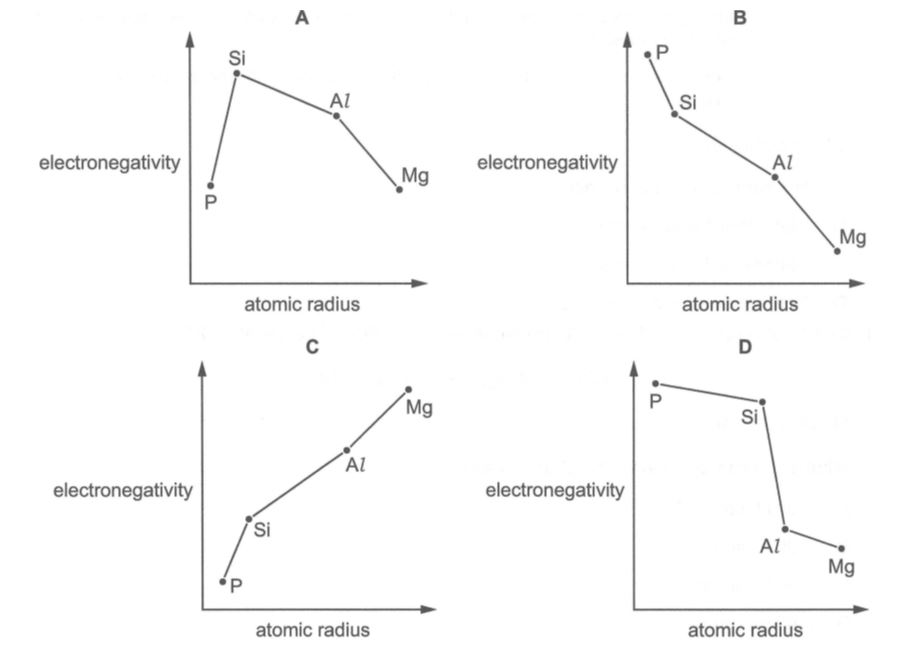
Which graph shows the correct trends when the electronegativity of each of the elements Mg, Al, Si and P is plotted against its atomic radius?
Video Solution
Explanation
The answer is B.
Across Period 3 from Mg to P, the nuclear charge increases while the shielding stays about the same, so the atomic radius decreases and the electronegativity increases. So on a plot of electronegativity against atomic radius, the order from left (smallest radius) to right must be P, Si, Al, Mg, with electronegativity falling from P to Mg.
Data Booklet atomic radii: P 0.110 nm, Si 0.117 nm, Al 0.143 nm, Mg 0.160 nm. The gap between P and Si (0.007 nm) is much smaller than the gap between Si and Al (0.026 nm), so P and Si sit close together horizontally.
Graph B shows P at the top left, Si just to its right and a little lower, then Al further right and lower, and Mg at the bottom right. This matches both trends and the spacing.
• A is wrong: it shows P with a lower electronegativity than Si and Al, but P is the most electronegative of the four.
• C is wrong: it shows electronegativity increasing with atomic radius, with Mg highest and P lowest, the reverse of the real trend.
• D is wrong: the order and direction are right, but it puts P and Si far apart in radius and Si and Al almost at the same radius; in fact Si (0.117 nm) is much closer in radius to P (0.110 nm) than to Al (0.143 nm).
Want Mr Khemistry to teach you this?
Join a live JC H2 Chemistry class at Bukit Timah, Tampines, or online. Come for a trial lesson, no obligation.
Book a trial classPractice this topic
20+ more Periodic table questions with shuffled options in ChemBank, free for everyone. Want more? The ChemBank Premium ($100/month) unlocks 4,000+ TYS and Prelim questions, Paper 2 & 3 practice with worked solutions, and all simulations.
Open ChemBank free