2024 H2 Chem P1 Q10 — Kinetics Solution
Question
In an experiment involving a large excess of Q, the graph of [P] against time has a constant half-life.
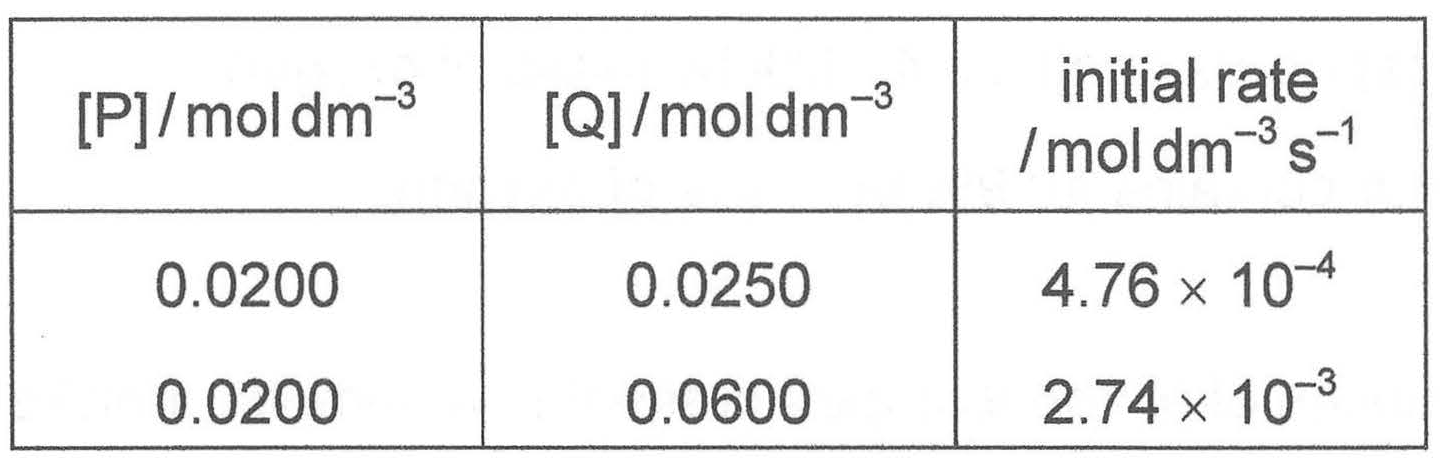
In further experiments, the rate of reaction is measured using different initial concentrations of Q.
The results are shown.
What is the numerical value of the rate constant?
Video Solution
Explanation
The answer is C (38.1).
• Order in P: with Q in large excess, [P] against time has a constant half-life, so the reaction is (pseudo) first order with respect to P.
• Order in Q: [P] is constant in both experiments while [Q] increases by \(\frac{0.0600}{0.0250} = 2.4\) times. The rate increases by \(\frac{2.74 \times 10^{-3}}{4.76 \times 10^{-4}} = 5.76\) times, and \(2.4^2 = 5.76\), so the reaction is second order with respect to Q.
• Rate equation: rate \(= k[\text{P}][\text{Q}]^2\)
• Using experiment 1: \(k = \frac{4.76 \times 10^{-4}}{0.0200 \times 0.0250^2} = \frac{4.76 \times 10^{-4}}{1.25 \times 10^{-5}} = 38.1\)
• A is wrong: 0.762 comes from rate \(= k[\text{Q}]^2\), leaving out [P].
• B is wrong: 0.952 comes from rate \(= k[\text{P}][\text{Q}]\), taking Q as first order.
• D is wrong: 47.6 comes from rate \(= k[\text{P}]^2[\text{Q}]\), swapping the orders of P and Q.
Want Mr Khemistry to teach you this?
Join a live JC H2 Chemistry class at Bukit Timah, Tampines, or online. Come for a trial lesson, no obligation.
Book a trial classPractice this topic
20+ more Kinetics questions with shuffled options in ChemBank, free for everyone. Want more? The ChemBank Premium ($100/month) unlocks 4,000+ TYS and Prelim questions, Paper 2 & 3 practice with worked solutions, and all simulations.
Open ChemBank free