2023 H2 Chem P1 Q6 — Atomic structure Solution
Question
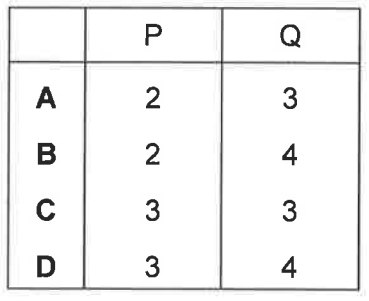
P is the number of Period 3 elements which have only one orbital in the outermost shell which contains just one electron.
Q is the number of Period 3 elements which have only one orbital in the outermost shell which contains a pair of electrons.
Which row is correct?
Video Solution
Explanation
The answer is D (P = 3, Q = 4).
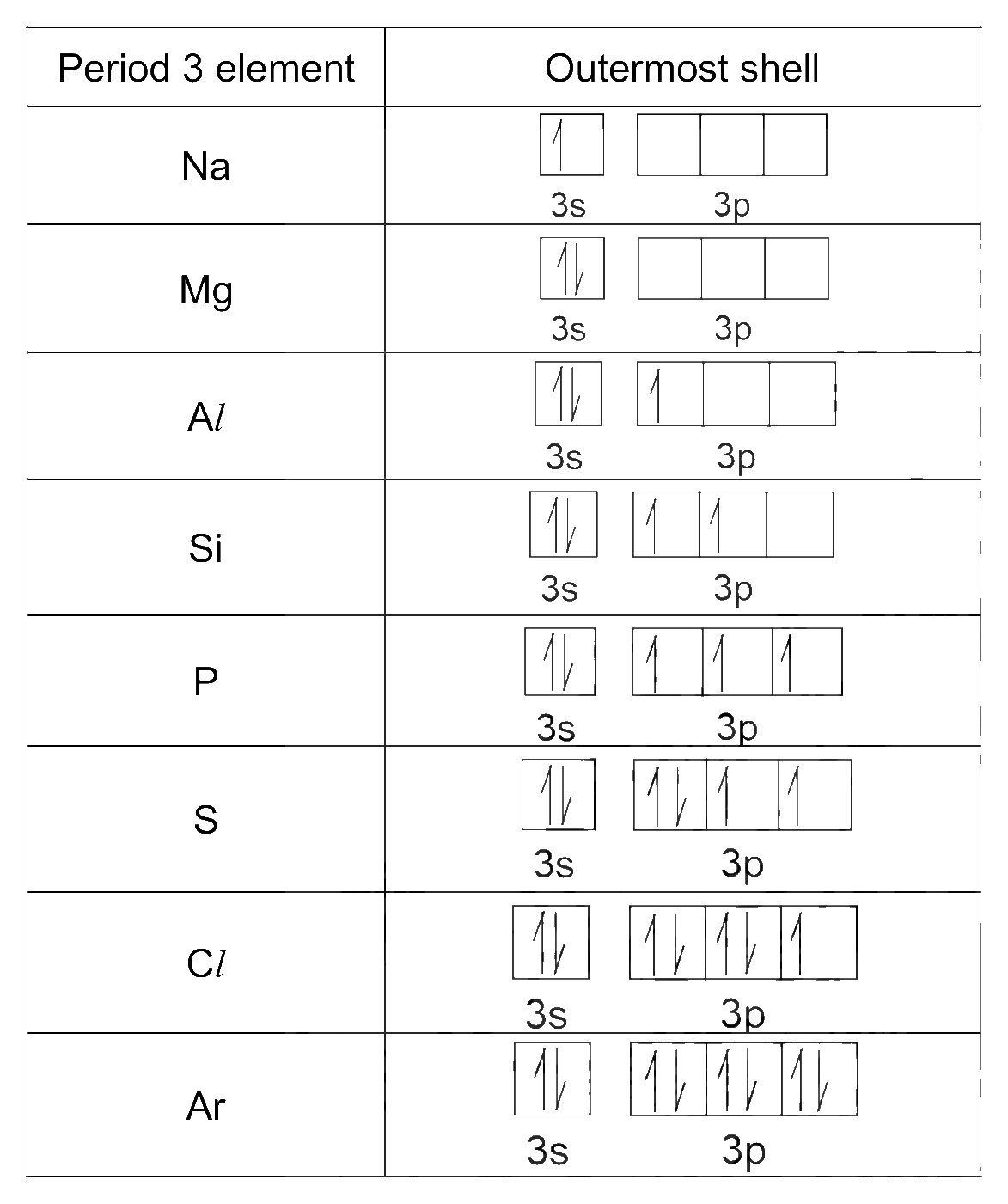
Write the outer shell (3s, 3p) of each Period 3 element, filling the 3p orbitals singly before pairing (as in the table):
• Na \(3s^1\): one singly-filled orbital, no paired orbital.
• Mg \(3s^2\): one paired orbital (3s), no singly-filled orbital.
• Al \(3s^2 3p^1\): one paired orbital (3s) and one singly-filled orbital (3p).
• Si \(3s^2 3p^2\): one paired orbital (3s) and two singly-filled orbitals.
• P \(3s^2 3p^3\): one paired orbital (3s) and three singly-filled orbitals.
• S \(3s^2 3p^4\): two paired orbitals and two singly-filled orbitals.
• Cl \(3s^2 3p^5\): three paired orbitals and one singly-filled orbital.
• Ar \(3s^2 3p^6\): four paired orbitals, no singly-filled orbital.
Only one orbital containing just one electron: Na, Al and Cl, so P = 3.
Only one orbital containing a pair of electrons: Mg, Al, Si and P, so Q = 4.
• A is wrong: P is 3 (Na, Al and Cl), not 2, and Q is 4 (Mg, Al, Si and P), not 3.
• B is wrong: Q = 4 is right, but P is 3, not 2; Na, Al and Cl each have exactly one singly-filled orbital.
• C is wrong: P = 3 is right, but Q is 4, not 3; Mg, Al, Si and P each have only the 3s orbital paired.
Want Mr Khemistry to teach you this?
Join a live JC H2 Chemistry class at Bukit Timah, Tampines, or online. Come for a trial lesson, no obligation.
Book a trial classPractice this topic
20+ more Atomic structure questions with shuffled options in ChemBank, free for everyone. Want more? The ChemBank Premium ($100/month) unlocks 4,000+ TYS and Prelim questions, Paper 2 & 3 practice with worked solutions, and all simulations.
Open ChemBank free