2023 H2 Chem P1 Q30 — Electrolysis Solution
Question
How long will it take for the concentration of the copper(II) sulfate to fall to 0.100 mol dm\(^{-3}\)?
Video Solution
Explanation
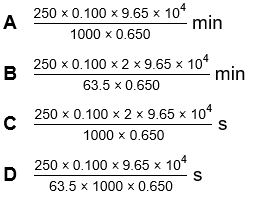
The answer is C.
With inert platinum electrodes, \(\text{Cu}^{2+}\) is reduced at the cathode: \(\text{Cu}^{2+} + 2\text{e}^- \rightarrow \text{Cu}\).
Amount of \(\text{Cu}^{2+}\) removed \(= (0.200 - 0.100) \times \frac{250}{1000} = 0.0250\) mol
Amount of electrons needed \(= 2 \times 0.0250 = 0.0500\) mol
\(Q = It = n_\text{e}F\), so \(0.650 \times t = 2 \times 0.100 \times \frac{250}{1000} \times 9.65 \times 10^4\)
\(t = \frac{250 \times 0.100 \times 2 \times 9.65 \times 10^4}{1000 \times 0.650}\) s \(= 7420\) s
The time comes out in seconds because the current is in amperes (C s\(^{-1}\)).
• A is wrong: it leaves out the factor of 2 (two electrons per \(\text{Cu}^{2+}\)), and the expression gives seconds, not minutes.
• B is wrong: it divides by 63.5 (the \(A_r\) of Cu) instead of 1000; the amount of \(\text{Cu}^{2+}\) comes from concentration \(\times\) volume in dm\(^3\), so no molar mass is needed. It is also labelled minutes instead of seconds.
• D is wrong: it leaves out the factor of 2 and includes an unnecessary division by 63.5, the \(A_r\) of Cu.
Want Mr Khemistry to teach you this?
Join a live JC H2 Chemistry class at Bukit Timah, Tampines, or online. Come for a trial lesson, no obligation.
Book a trial classPractice this topic
20+ more Electrolysis questions with shuffled options in ChemBank, free for everyone. Want more? The ChemBank Premium ($100/month) unlocks 4,000+ TYS and Prelim questions, Paper 2 & 3 practice with worked solutions, and all simulations.
Open ChemBank free