2023 H2 Chem P1 Q3 — Chemical bonding Solution
Question
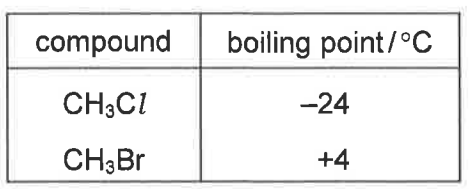
Which statement explains the relative boiling points of \(\text{CH}_3\text{Cl}\) and \(\text{CH}_3\text{Br}\)?
Video Solution
Explanation
The answer is C (bromine atoms contain more electrons than chlorine atoms).
\(\text{CH}_3\text{Br}\) (b.p. +4 °C) boils higher than \(\text{CH}_3\text{Cl}\) (b.p. -24 °C), so the total intermolecular forces in \(\text{CH}_3\text{Br}\) must be stronger.
Br has more electrons than Cl, so \(\text{CH}_3\text{Br}\) has a larger, more polarisable electron cloud and stronger id-id interactions. This outweighs the slightly stronger pd-pd interactions in the more polar \(\text{CH}_3\text{Cl}\), so more energy is needed to overcome the intermolecular forces in \(\text{CH}_3\text{Br}\).
A: True, but Cl being more electronegative makes \(\text{CH}_3\text{Cl}\) more polar with stronger pd-pd interactions, which would give \(\text{CH}_3\text{Cl}\) the higher boiling point. It does not explain the data.
B: Neither compound has an H atom bonded to N, O or F, so there is no hydrogen bonding between molecules of either compound.
D: Boiling a simple molecular substance overcomes the intermolecular forces between molecules; the covalent bonds within the molecules are not broken, so their strength does not decide the boiling point.
Want Mr Khemistry to teach you this?
Join a live JC H2 Chemistry class at Bukit Timah, Tampines, or online. Come for a trial lesson, no obligation.
Book a trial classPractice this topic
20+ more Chemical bonding questions with shuffled options in ChemBank, free for everyone. Want more? The ChemBank Premium ($100/month) unlocks 4,000+ TYS and Prelim questions, Paper 2 & 3 practice with worked solutions, and all simulations.
Open ChemBank free