2023 H2 Chem P1 Q27 — Nitrogen Compound Solution
Question
Which structures are tripeptides?
1) H2NCHRCONHCHR’CONHCHR’’NH2
2) H2NCHRCONHCHR’CONHCHR’’CO2H
3) HO2CCHRNHCOCHR’NHCOCHR’’NH2
Video Solution
Explanation
The answer is D (2 and 3 only).
An amino acid is \(\text{H}_2\text{NCHRCO}_2\text{H}\); in a peptide each amino acid becomes a residue \(-\text{NHCHRCO}-\), joined to the next by an amide (peptide) link. A tripeptide is three such residues, with a free \(-\text{NH}_2\) at one end and a free \(-\text{CO}_2\text{H}\) at the other.
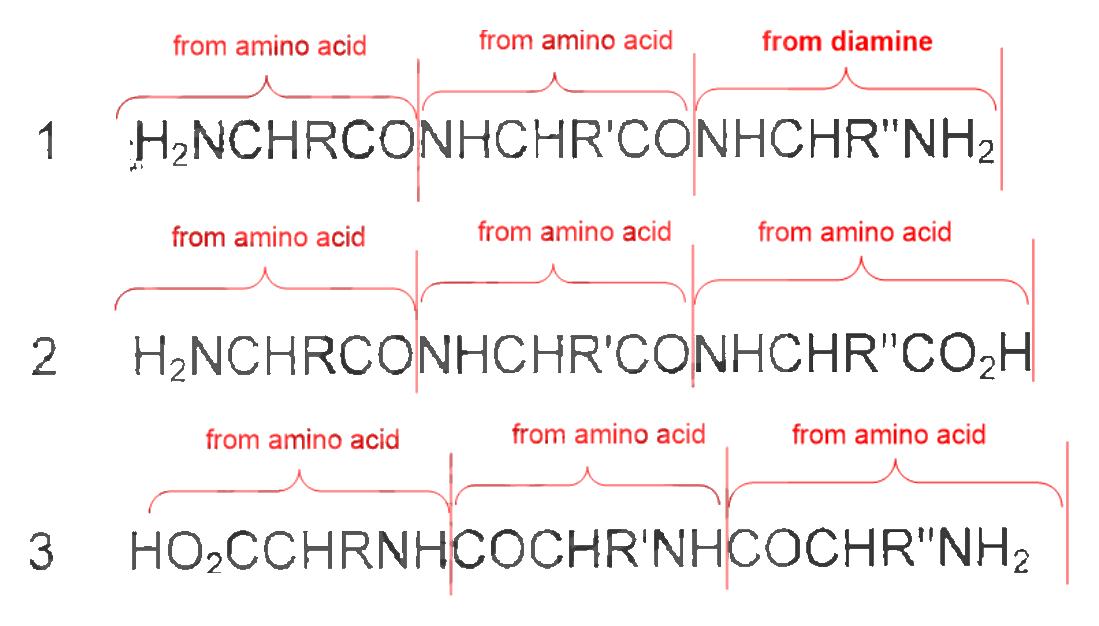
• Structure 1, not a tripeptide. It splits into \(\text{H}_2\text{NCHRCO}\), \(\text{NHCHR'CO}\) and \(\text{NHCHR''NH}_2\). The last unit has no C=O and ends in \(\text{NH}_2\), so it comes from a diamine, not an amino acid.
• Structure 2, a tripeptide. \(\text{H}_2\text{NCHRCO}\), \(\text{NHCHR'CO}\) and \(\text{NHCHR''CO}_2\text{H}\) are three amino acid residues joined by two amide links.
• Structure 3, a tripeptide. It is written from the \(-\text{CO}_2\text{H}\) end: \(\text{HO}_2\text{CCHRNH}\), \(\text{COCHR'NH}\) and \(\text{COCHR''NH}_2\) are again three amino acid residues joined by two amide links.
A, B and C: all include structure 1, which contains a diamine unit and so is not a tripeptide.
Want Mr Khemistry to teach you this?
Join a live JC H2 Chemistry class at Bukit Timah, Tampines, or online. Come for a trial lesson, no obligation.
Book a trial classPractice this topic
20+ more Nitrogen Compound questions with shuffled options in ChemBank, free for everyone. Want more? The ChemBank Premium ($100/month) unlocks 4,000+ TYS and Prelim questions, Paper 2 & 3 practice with worked solutions, and all simulations.
Open ChemBank free