2023 H2 Chem P1 Q26 — Carboxylic Acid Solution
Question
[D = \(^2_1\text{H}\)]
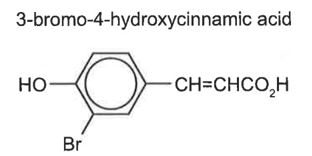
What is the maximum number of hydrogen atoms which could be replaced by deuterium atoms in each molecule of 3-bromo-4-hydroxycinnamic acid?
Video Solution
Explanation
The answer is B (2).
Only acidic hydrogen atoms, those bonded to O in the phenol \(-\text{OH}\) and the carboxylic acid \(-\text{CO}_2\text{H}\), can be exchanged. For example:
\(\text{RCOOH} + \text{D}_2\text{O} \rightleftharpoons \text{RCOO}^- + \text{HD}_2\text{O}^+\)
In the reverse reaction, \(\text{RCOO}^-\) can take back a D instead of an H, forming RCOOD. With a large excess of \(\text{D}_2\text{O}\), the H is replaced by D. The phenol O-H exchanges in the same way. So a maximum of 2 H atoms can be replaced.
The C-H hydrogens (3 on the ring and 2 on the CH=CH) are not acidic and do not ionise, so they are not replaced.
• A is wrong: it counts only the \(-\text{CO}_2\text{H}\) hydrogen, but the phenol \(-\text{OH}\) is also acidic and exchanges with \(\text{D}_2\text{O}\).
• C is wrong: 4 would add the 2 alkene C-H hydrogens to the 2 O-H hydrogens, but C-H hydrogens do not ionise.
• D is wrong: 5 is the number of C-H hydrogens (3 ring + 2 alkene), none of which is acidic.
Want Mr Khemistry to teach you this?
Join a live JC H2 Chemistry class at Bukit Timah, Tampines, or online. Come for a trial lesson, no obligation.
Book a trial classPractice this topic
20+ more Carboxylic Acid questions with shuffled options in ChemBank, free for everyone. Want more? The ChemBank Premium ($100/month) unlocks 4,000+ TYS and Prelim questions, Paper 2 & 3 practice with worked solutions, and all simulations.
Open ChemBank free