2023 H2 Chem P1 Q25 — Carboxylic Acid Solution
Question
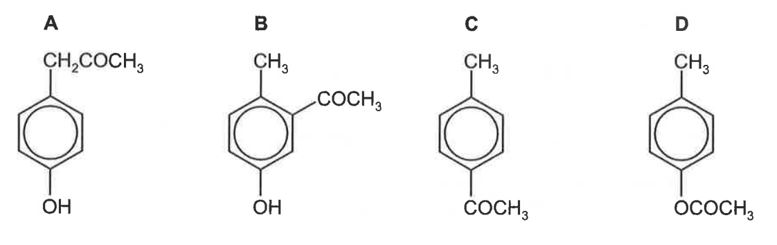
What is the structure of the organic product?
Video Solution
Explanation
The answer is D.
Ethanoyl chloride acylates the \(-\text{OH}\) group of 4-methylphenol: the phenol O atom, using a lone pair, attacks the electron-deficient carbonyl carbon and HCl is eliminated. The product is the ester 4-methylphenyl ethanoate, with \(-\text{OCOCH}_3\) para to the \(\text{CH}_3\) group, as drawn in D.
• A is wrong: it shows \(-\text{COCH}_3\) replacing an H on the methyl side chain; ethanoyl chloride does not substitute the C-H of an alkyl group.
• B is wrong: it shows \(-\text{COCH}_3\) on the ring next to the methyl group (ring acylation); this is Friedel-Crafts acylation, which needs a Lewis acid catalyst such as \(\text{AlCl}_3\), and the free \(-\text{OH}\) would react first.
• C is wrong: it shows \(-\text{COCH}_3\) where the \(-\text{OH}\) group was, so the OH has been lost; the C-O bond of a phenol has partial double bond character and is not broken in this reaction.
Want Mr Khemistry to teach you this?
Join a live JC H2 Chemistry class at Bukit Timah, Tampines, or online. Come for a trial lesson, no obligation.
Book a trial classPractice this topic
20+ more Carboxylic Acid questions with shuffled options in ChemBank, free for everyone. Want more? The ChemBank Premium ($100/month) unlocks 4,000+ TYS and Prelim questions, Paper 2 & 3 practice with worked solutions, and all simulations.
Open ChemBank free