2023 H2 Chem P1 Q24 — Alkane Solution
Question
Video Solution
Explanation
The answer is B (1 and 2 only).
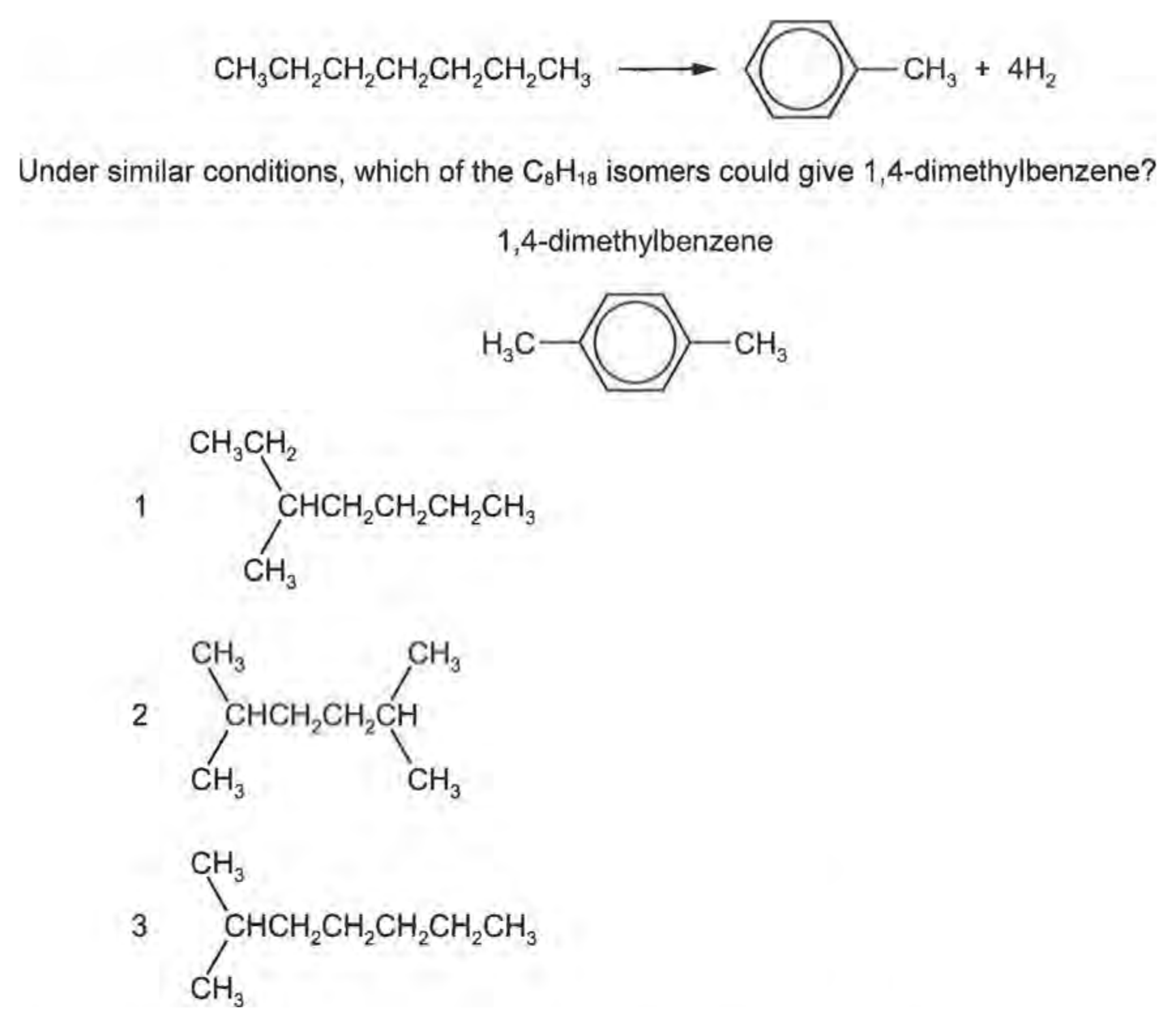
In the example, heptane loses \(4\text{H}_2\): a chain of six consecutive carbons closes into a ring (a new bond forms between the first and sixth carbons of that stretch) and becomes aromatic, while the carbon left over stays as a substituent, giving methylbenzene.
For 1,4-dimethylbenzene (\(\text{C}_8\text{H}_{18} \rightarrow \text{C}_8\text{H}_{10} + 4\text{H}_2\)), the \(\text{C}_8\text{H}_{18}\) isomer must contain a six-carbon stretch whose two leftover carbons end up as methyl groups on ring carbons 1 and 4 (opposite each other).
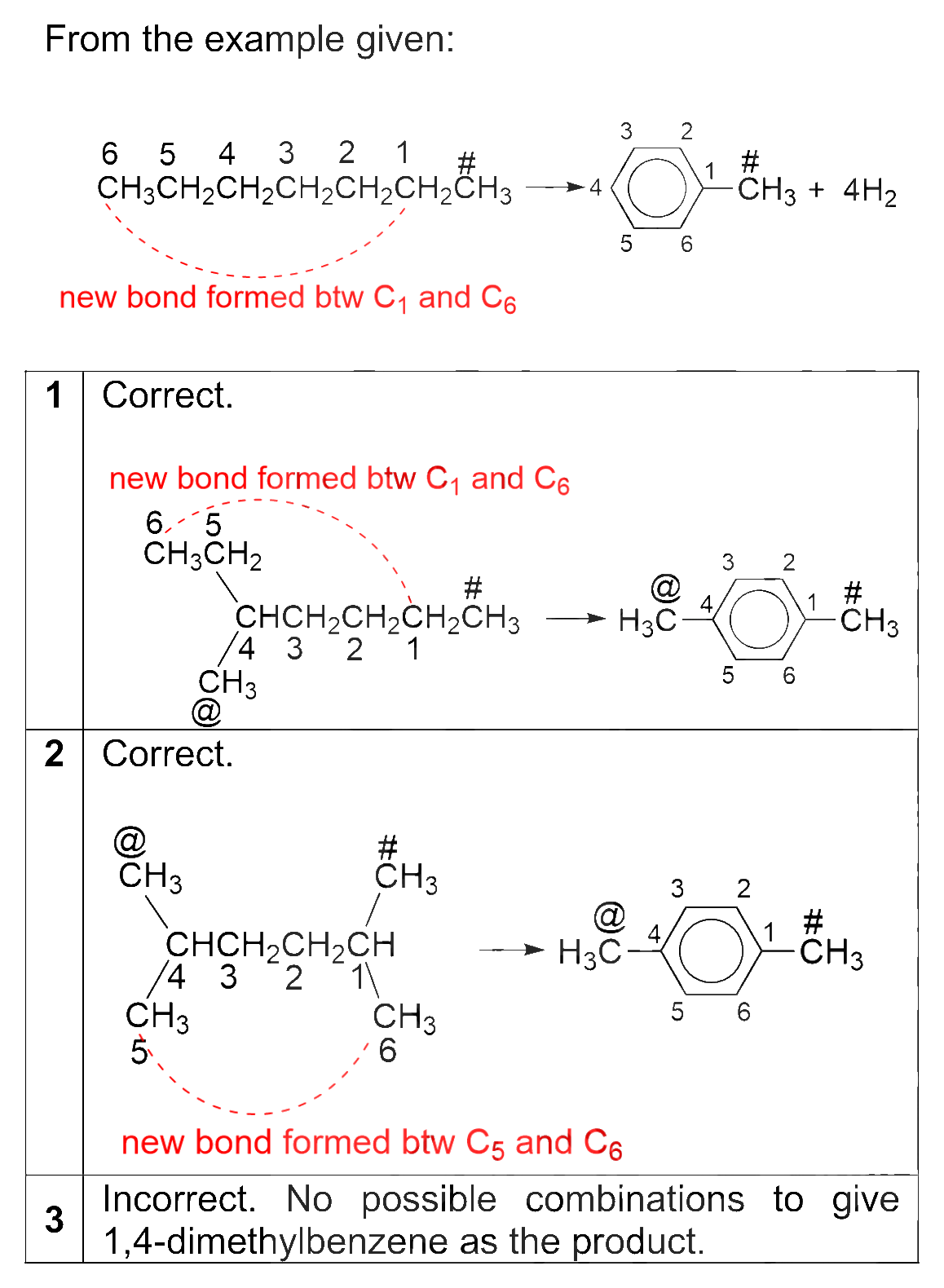
• Isomer 1 (3-methylheptane), correct. Number the stretch from the \(\text{CH}_3\) of the ethyl group (C6), its \(\text{CH}_2\) (C5), the CH (C4), then the three \(\text{CH}_2\) groups (C3, C2, C1). Joining C1 and C6 leaves the branch methyl on C4 and the terminal \(\text{CH}_3\) on C1, which are para.
• Isomer 2 (2,5-dimethylhexane), correct. Take one methyl on the left CH (C5), that CH (C4), the two \(\text{CH}_2\) groups (C3, C2), the right CH (C1) and one of its methyls (C6). Joining C5 and C6 leaves the other two methyls on C4 and C1, which are para.
• Isomer 3 (2-methylheptane), incorrect. Every possible six-carbon stretch either puts both leftover carbons on the same ring carbon (not possible in an aromatic ring) or puts them on ring carbons 1 and 3, giving 1,3-dimethylbenzene. No arrangement gives 1,4-dimethylbenzene.
A: includes isomer 3, which cannot give the 1,4 product.
C: includes isomer 3 and leaves out isomer 1.
D: leaves out isomer 2, which also gives 1,4-dimethylbenzene.
Want Mr Khemistry to teach you this?
Join a live JC H2 Chemistry class at Bukit Timah, Tampines, or online. Come for a trial lesson, no obligation.
Book a trial classPractice this topic
20+ more Alkane questions with shuffled options in ChemBank, free for everyone. Want more? The ChemBank Premium ($100/month) unlocks 4,000+ TYS and Prelim questions, Paper 2 & 3 practice with worked solutions, and all simulations.
Open ChemBank free