2023 H2 Chem P1 Q19 — Arene Solution
Question
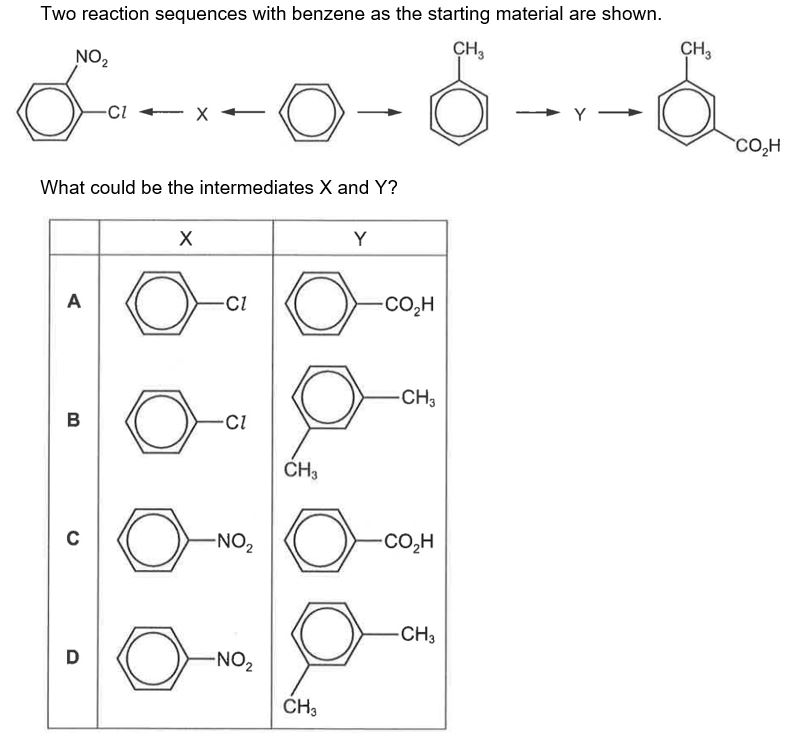
Two reaction sequences with benzene as the starting material are shown.
Video Solution
Explanation
The answer is A (X is chlorobenzene, Y is benzoic acid).
• X: the final product has Cl and \(\text{NO}_2\) on adjacent carbons (1,2). Cl is 2,4-directing, so if X is chlorobenzene (from \(\text{Cl}_2\) with \(\text{AlCl}_3\)), nitration puts \(\text{NO}_2\) at position 2 (and 4), giving the 1,2 product. The nitro group is 3-directing, so chlorinating nitrobenzene would put Cl at position 3, not position 2.
• Y: the final product has \(\text{CH}_3\) and \(\text{CO}_2\text{H}\) on carbons 1 and 3. Methylbenzene is first oxidised (\(\text{KMnO}_4\), heat) to benzoic acid, Y. The \(-\text{CO}_2\text{H}\) group is 3-directing, so adding a methyl group (\(\text{CH}_3\text{Cl}\) with \(\text{AlCl}_3\)) puts it at position 3.
• B is wrong: X is right, but Y cannot be 1,3-dimethylbenzene. The \(\text{CH}_3\) group of methylbenzene is 2,4-directing, so methylation would not give the 1,3 isomer, and oxidising 1,3-dimethylbenzene with \(\text{KMnO}_4\) would oxidise both methyl groups, not just one.
• C is wrong: Y is right, but X cannot be nitrobenzene, because \(\text{NO}_2\) is 3-directing and chlorination would give the 1,3 product.
• D is wrong: both intermediates are wrong, for the reasons given for B and C.
Want Mr Khemistry to teach you this?
Join a live JC H2 Chemistry class at Bukit Timah, Tampines, or online. Come for a trial lesson, no obligation.
Book a trial classPractice this topic
20+ more Arene questions with shuffled options in ChemBank, free for everyone. Want more? The ChemBank Premium ($100/month) unlocks 4,000+ TYS and Prelim questions, Paper 2 & 3 practice with worked solutions, and all simulations.
Open ChemBank free