2023 H2 Chem P1 Q17 — Introduction to Organic Solution
Question
Which statement best explains the lack of reactivity of \(\text{CH}_2=\text{CHCl}\) to nucleophiles?
Video Solution
Explanation
The answer is C.
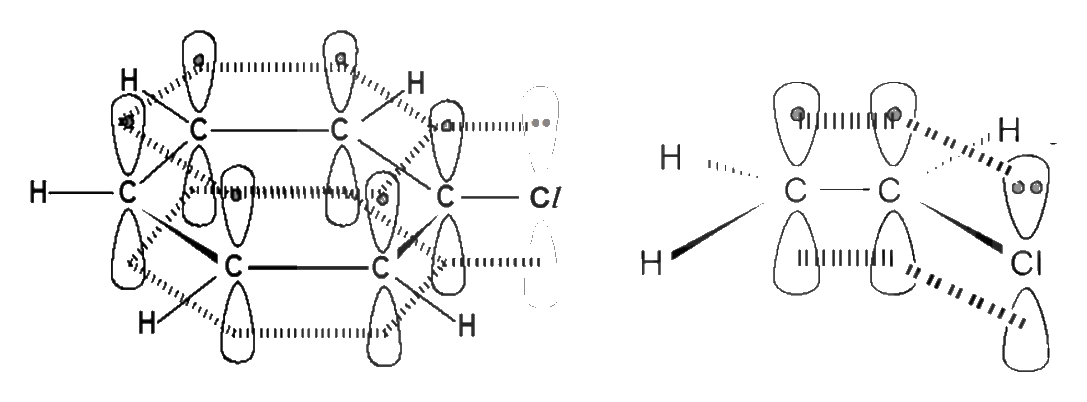
In chloroethene, the Cl atom is bonded directly to a C=C carbon. A p orbital on Cl containing a lone pair overlaps sideways with the \(\pi\) bond, so the lone pair is delocalised into the C=C (as in chlorobenzene, shown in the diagram). The C-Cl bond gains partial double bond character, becomes stronger and is hard to break, so Cl is not easily substituted by a nucleophile. The electron-rich \(\pi\) cloud next to the C-Cl carbon also repels an approaching nucleophile.
In 3-chloropropene, Cl is on an \(sp^3\) carbon that is not part of the C=C, so there is no such overlap and the C-Cl bond is an ordinary single bond that is readily attacked.
• A is wrong: 3-chloropropene is also a substituted alkene, yet it reacts readily with nucleophiles (substitution at the \(\text{CH}_2\text{Cl}\) carbon), so substituted alkenes do not undergo only electrophilic addition.
• B is wrong: electron-withdrawing groups would make the carbon more electron-deficient and so more open to nucleophilic attack, not less; also the Cl atom here donates its lone pair into the \(\pi\) system.
• D is wrong: restricted rotation does not affect how easily the C-Cl bond is broken; the C-Cl bond is hard to break because of the p-orbital overlap described in C (the \(\pi\) bond restricts rotation about the C=C bond).
Want Mr Khemistry to teach you this?
Join a live JC H2 Chemistry class at Bukit Timah, Tampines, or online. Come for a trial lesson, no obligation.
Book a trial classPractice this topic
20+ more Introduction to Organic questions with shuffled options in ChemBank, free for everyone. Want more? The ChemBank Premium ($100/month) unlocks 4,000+ TYS and Prelim questions, Paper 2 & 3 practice with worked solutions, and all simulations.
Open ChemBank free