2023 H2 Chem P1 Q11 — Kinetics Solution
Question
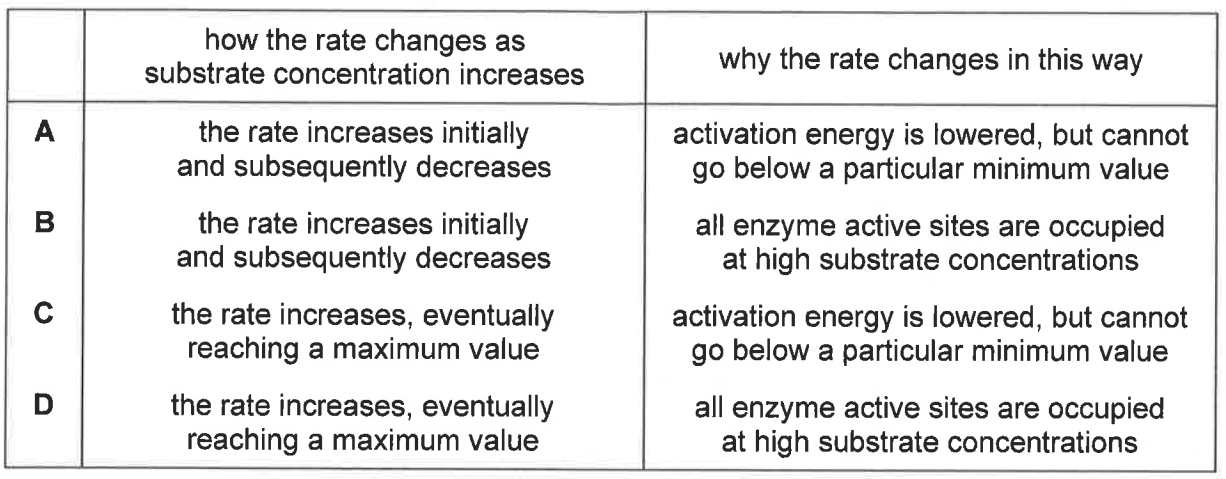
Which row correctly describes how the rate changes, and gives the correct reason why it changes in this way?
Video Solution
Explanation
The answer is D (the rate increases, eventually reaching a maximum value; all enzyme active sites are occupied at high substrate concentrations).
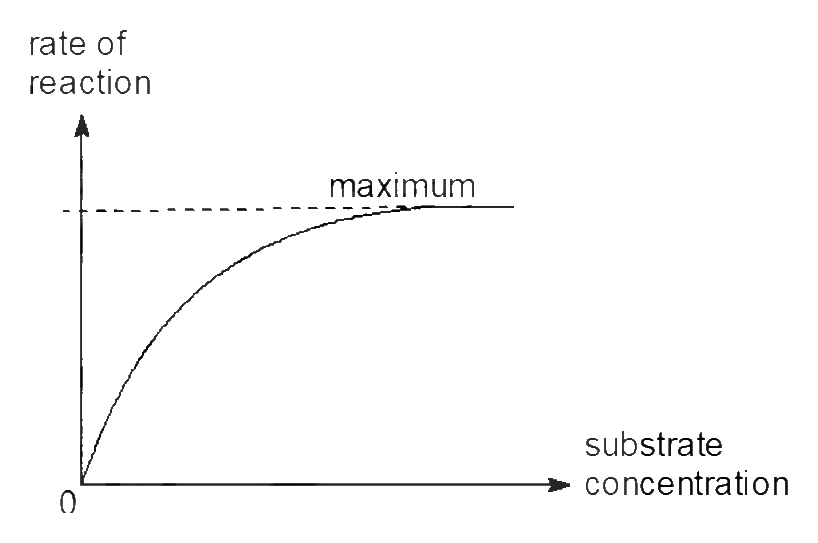
The graph shows the rate rising and then levelling off at a maximum.
At low [substrate], not all of the active sites are occupied. The rate is proportional to [substrate], so the reaction is first order with respect to the substrate.
At high [substrate], all the active sites are occupied, i.e. the enzyme is saturated with substrate. Any further increase in [substrate] has no effect on the rate, so the rate reaches a maximum and the reaction becomes zero order with respect to the substrate.
• A is wrong: the rate does not decrease at high [substrate], it levels off at a maximum; and the reason is wrong (see C).
• B is wrong: the reason is right, but saturation of the active sites makes the rate level off, not decrease.
• C is wrong: the description is right, but the reason is not. The enzyme lowers the activation energy by providing an alternative pathway, and this activation energy does not change with substrate concentration. The maximum rate is reached because every active site is occupied, not because the activation energy stops falling.
Want Mr Khemistry to teach you this?
Join a live JC H2 Chemistry class at Bukit Timah, Tampines, or online. Come for a trial lesson, no obligation.
Book a trial classPractice this topic
20+ more Kinetics questions with shuffled options in ChemBank, free for everyone. Want more? The ChemBank Premium ($100/month) unlocks 4,000+ TYS and Prelim questions, Paper 2 & 3 practice with worked solutions, and all simulations.
Open ChemBank free