2023 H2 Chem P1 Q1 — Atomic structure Solution
Question
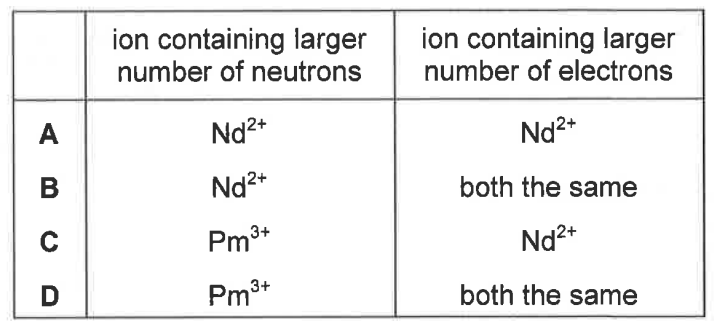
Neodymium, Nd, and promethium, Pm, are both lanthanoids. An isotope of \(\text{Nd}^{2+}\) and an isotope of \(\text{Pm}^{3+}\) both have 145 nucleons.
Which row of the table is correct?
Video Solution
Explanation
The answer is B.
From the Data Booklet, Nd has proton number 60 and Pm has proton number 61. Both isotopes have 145 nucleons (protons + neutrons).
• \(\text{Nd}^{2+}\): neutrons \(= 145 - 60 = 85\); electrons \(= 60 - 2 = 58\).
• \(\text{Pm}^{3+}\): neutrons \(= 145 - 61 = 84\); electrons \(= 61 - 3 = 58\).
So \(\text{Nd}^{2+}\) has more neutrons (85 against 84) and both ions have the same number of electrons (58), which is row B.
• A is wrong: both ions have 58 electrons, so \(\text{Nd}^{2+}\) does not have more electrons.
• C is wrong: \(\text{Pm}^{3+}\) has fewer neutrons (84), and \(\text{Nd}^{2+}\) does not have more electrons.
• D is wrong: the electron column is right, but \(\text{Pm}^{3+}\) has fewer neutrons than \(\text{Nd}^{2+}\) (84 against 85), because Pm has one more proton in the same 145 nucleons.
Want Mr Khemistry to teach you this?
Join a live JC H2 Chemistry class at Bukit Timah, Tampines, or online. Come for a trial lesson, no obligation.
Book a trial classPractice this topic
20+ more Atomic structure questions with shuffled options in ChemBank, free for everyone. Want more? The ChemBank Premium ($100/month) unlocks 4,000+ TYS and Prelim questions, Paper 2 & 3 practice with worked solutions, and all simulations.
Open ChemBank free