2022 H2 Chem P1 Q9 — Thermochemistry Solution
Question
Video Solution
Explanation
The answer is B (\(\Delta H_1 > \Delta H_3 > \Delta H_2\)).
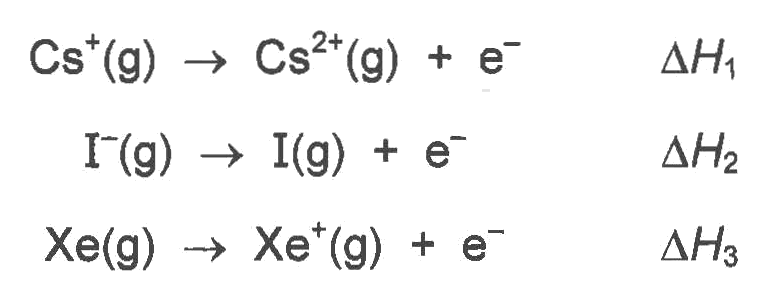
In each change one electron is removed from a species with the same electronic configuration: \(\text{Cs}^+\), Xe and \(\text{I}^-\) are isoelectronic, all [Kr]\(4d^{10}5s^25p^6\). The electron is removed from the same 5p subshell with the same shielding in each.
The nuclear charge decreases from \(\text{Cs}^+\) (55 protons) to Xe (54) to \(\text{I}^-\) (53), so the attraction between the nucleus and the 5p electron decreases in that order and less energy is needed to remove it.
So \(\Delta H_1\) (\(\text{Cs}^+\)) \(>\) \(\Delta H_3\) (Xe) \(>\) \(\Delta H_2\) (\(\text{I}^-\)).
• A is wrong: it puts \(\Delta H_2\) above \(\Delta H_3\), but \(\text{I}^-\) has one proton fewer than Xe, so its electron is removed more easily.
• C is wrong: \(\Delta H_2\) (\(\text{I}^-\), lowest nuclear charge) is the smallest, not the largest.
• D is wrong: \(\Delta H_2\) is the smallest and \(\Delta H_1\) (\(\text{Cs}^+\), highest nuclear charge) is the largest, the reverse of this order.
Want Mr Khemistry to teach you this?
Join a live JC H2 Chemistry class at Bukit Timah, Tampines, or online. Come for a trial lesson, no obligation.
Book a trial classPractice this topic
20+ more Thermochemistry questions with shuffled options in ChemBank, free for everyone. Want more? The ChemBank Premium ($100/month) unlocks 4,000+ TYS and Prelim questions, Paper 2 & 3 practice with worked solutions, and all simulations.
Open ChemBank free