2022 H2 Chem P1 Q3 — Acid base equilibrium Solution
Question
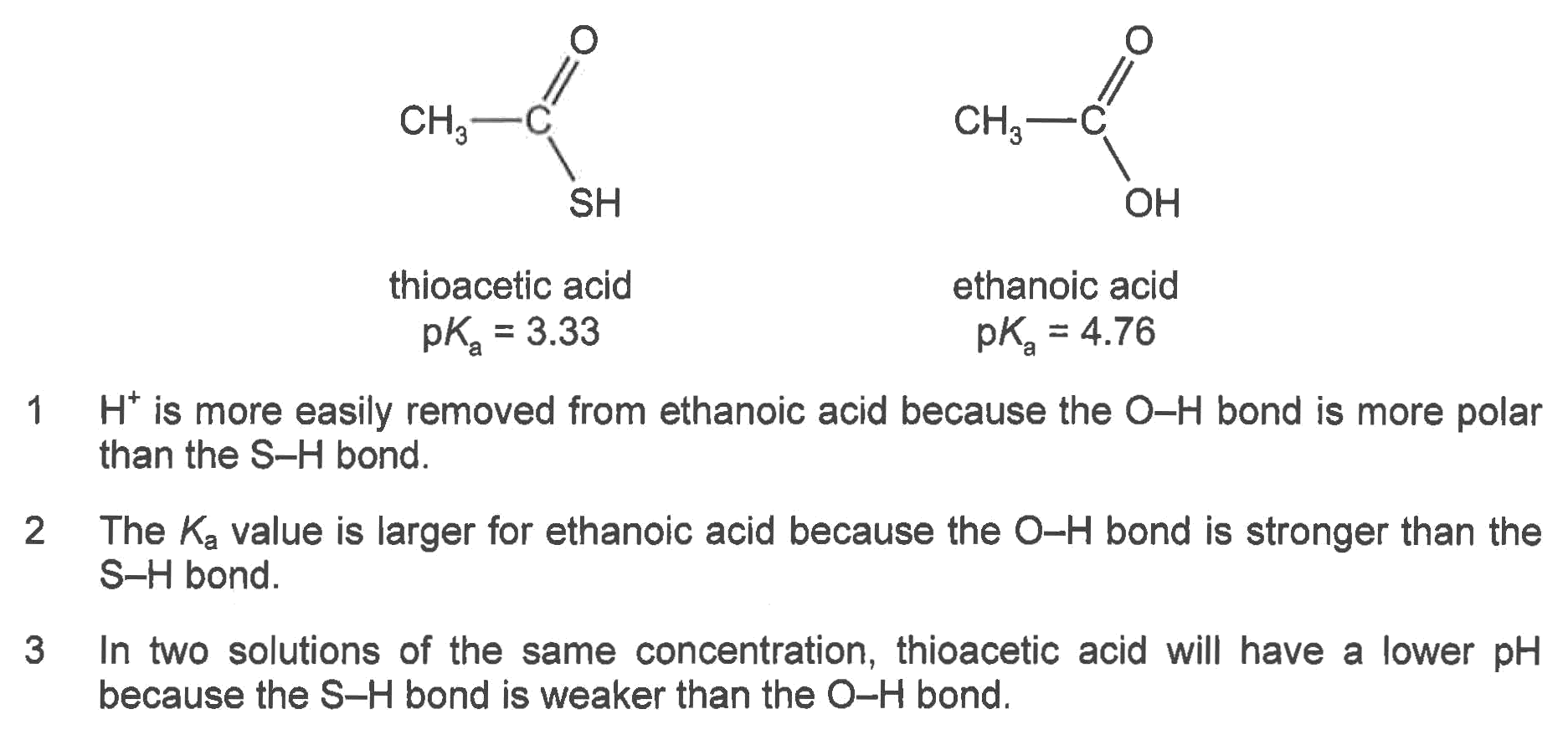
Which statements are correct?
Video Solution
Explanation
The answer is D (3 only).
A smaller \(\text{p}K_\text{a}\) means a larger \(K_\text{a}\) and a stronger acid. Thioacetic acid (\(\text{p}K_\text{a}\) = 3.33, \(K_\text{a} = 4.7 \times 10^{-4}\)) is a stronger acid than ethanoic acid (\(\text{p}K_\text{a}\) = 4.76, \(K_\text{a} = 1.7 \times 10^{-5}\)).
• Statement 1 is false: \(\text{H}^+\) is more easily removed from thioacetic acid, the stronger acid, not from ethanoic acid. The data show that the weaker S-H bond outweighs the greater polarity of the O-H bond.
• Statement 2 is false: ethanoic acid has the larger \(\text{p}K_\text{a}\), so its \(K_\text{a}\) is smaller. A stronger O-H bond makes ethanoic acid ionise less, which lowers \(K_\text{a}\), not raises it.
• Statement 3 is true: the S-H bond is weaker than the O-H bond, so thioacetic acid ionises to a greater extent. At the same concentration it gives a higher \([\text{H}^+]\) and so a lower pH.
• A is wrong: statements 1 and 2 are false.
• B is wrong: statements 1 and 2 are both false, and it leaves out statement 3, which is true.
• C is wrong: statement 2 is false.
Want Mr Khemistry to teach you this?
Join a live JC H2 Chemistry class at Bukit Timah, Tampines, or online. Come for a trial lesson, no obligation.
Book a trial classPractice this topic
20+ more Acid base equilibrium questions with shuffled options in ChemBank, free for everyone. Want more? The ChemBank Premium ($100/month) unlocks 4,000+ TYS and Prelim questions, Paper 2 & 3 practice with worked solutions, and all simulations.
Open ChemBank free