2022 H2 Chem P1 Q29 — Electrochemical cell Solution
Question
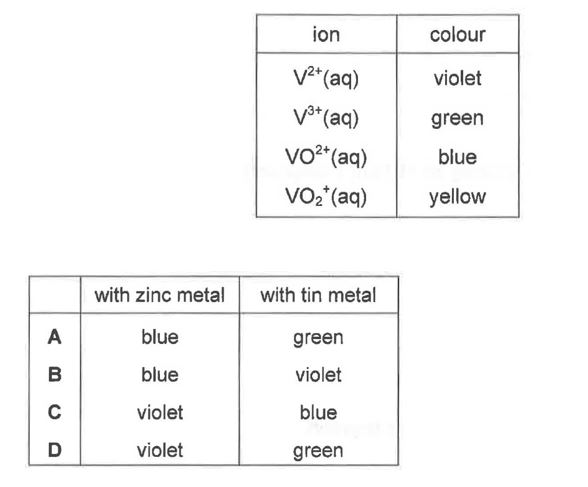
Vanadium forms a number of coloured aqueous ions. What are the colours of the resulting solutions if an acidic solution of \(\text{VO}_2^+\text{(aq)}\) is reacted separately with an excess of zinc metal and with an excess of tin metal?
Video Solution
Explanation
The answer is D.
Data Booklet values:
• \(\text{VO}_2^+ + 2\text{H}^+ + \text{e}^- \rightleftharpoons \text{VO}^{2+} + \text{H}_2\text{O}\) \(E^\ominus = +1.00\) V
• \(\text{VO}^{2+} + 2\text{H}^+ + \text{e}^- \rightleftharpoons \text{V}^{3+} + \text{H}_2\text{O}\) \(E^\ominus = +0.34\) V
• \(\text{V}^{3+} + \text{e}^- \rightleftharpoons \text{V}^{2+}\) \(E^\ominus = -0.26\) V
• \(\text{V}^{2+} + 2\text{e}^- \rightleftharpoons \text{V}\) \(E^\ominus = -1.20\) V
• \(\text{Zn}^{2+} + 2\text{e}^- \rightleftharpoons \text{Zn}\) \(E^\ominus = -0.76\) V
• \(\text{Sn}^{2+} + 2\text{e}^- \rightleftharpoons \text{Sn}\) \(E^\ominus = -0.14\) V
Zinc: \(E^\ominus(\text{Zn}^{2+}/\text{Zn}) = -0.76\) V is more negative than the \(E^\ominus\) values for \(\text{VO}_2^+/\text{VO}^{2+}\), \(\text{VO}^{2+}/\text{V}^{3+}\) and \(\text{V}^{3+}/\text{V}^{2+}\), so \(E^\ominus_\text{cell} > 0\) for each step and Zn reduces \(\text{VO}_2^+\) all the way to \(\text{V}^{2+}\). It cannot reduce \(\text{V}^{2+}\) to V, since \(E^\ominus_\text{cell} = -1.20 - (-0.76) = -0.44\) V. The solution is violet.
Tin: \(E^\ominus(\text{Sn}^{2+}/\text{Sn}) = -0.14\) V is more negative than the values for \(\text{VO}_2^+/\text{VO}^{2+}\) (+1.00 V) and \(\text{VO}^{2+}/\text{V}^{3+}\) (+0.34 V), so Sn reduces \(\text{VO}_2^+\) to \(\text{V}^{3+}\). It cannot reduce \(\text{V}^{3+}\) to \(\text{V}^{2+}\), since \(E^\ominus_\text{cell} = -0.26 - (-0.14) = -0.12\) V. The solution is green.
• A and B are wrong: zinc does not stop at \(\text{VO}^{2+}\) (blue); it goes on to \(\text{V}^{2+}\) (violet). B is also wrong because tin cannot reach \(\text{V}^{2+}\).
• C is wrong: tin does not stop at \(\text{VO}^{2+}\) (blue); \(E^\ominus_\text{cell} = +0.34 - (-0.14) = +0.48\) V, so it reduces \(\text{VO}^{2+}\) further to \(\text{V}^{3+}\) (green).
Want Mr Khemistry to teach you this?
Join a live JC H2 Chemistry class at Bukit Timah, Tampines, or online. Come for a trial lesson, no obligation.
Book a trial classPractice this topic
20+ more Electrochemical cell questions with shuffled options in ChemBank, free for everyone. Want more? The ChemBank Premium ($100/month) unlocks 4,000+ TYS and Prelim questions, Paper 2 & 3 practice with worked solutions, and all simulations.
Open ChemBank free