2022 H2 Chem P1 Q28 — Carbonyl Compound Solution
Question
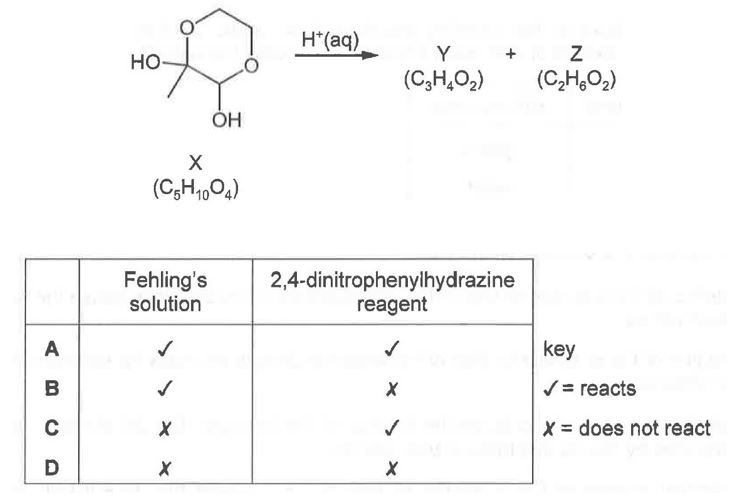
Y reacts with alkaline aqueous iodine, but Z does not.
Z reacts with sodium metal, but Y does not.
Which other reactions will compound Y undergo?
Video Solution
Explanation
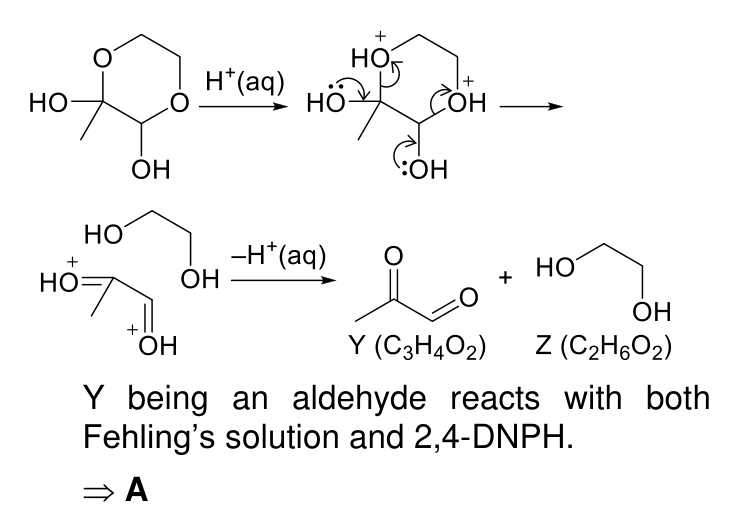
The answer is A (Y reacts with Fehling's solution and with 2,4-dinitrophenylhydrazine).
Deducing Y (\(\text{C}_3\text{H}_4\text{O}_2\)) from the tests:
• Y does not react with sodium, so it has no \(-\text{OH}\) group.
• Y turns hot acidified \(\text{K}_2\text{Cr}_2\text{O}_7\) green, so it is oxidised. With no \(-\text{OH}\) group, it must contain an aldehyde, \(-\text{CHO}\).
• Y reacts with alkaline aqueous iodine, so it contains a \(\text{CH}_3\text{CO}-\) group.
So Y is \(\text{CH}_3\text{COCHO}\) (2-oxopropanal). This fits the acid-catalysed breakdown of X shown in the explanation figure: the two C-O bonds of the ring break to give Y and Z, ethane-1,2-diol, \(\text{HOCH}_2\text{CH}_2\text{OH}\) (\(\text{C}_2\text{H}_6\text{O}_2\)), which reacts with sodium and is oxidised by dichromate but has no \(\text{CH}_3\text{CO}-\) or \(\text{CH}_3\text{CH(OH)}-\) group for the iodoform test.
• Fehling's solution: Y has an aliphatic aldehyde group, so it reduces Fehling's solution, giving a red-brown precipitate of \(\text{Cu}_2\text{O}\).
• 2,4-dinitrophenylhydrazine: Y has C=O groups (aldehyde and ketone), so it gives an orange precipitate by condensation.
• B is wrong: Y has C=O groups, so it does react with 2,4-dinitrophenylhydrazine.
• C is wrong: Y is an aliphatic aldehyde, so it does react with Fehling's solution.
• D is wrong: Y reacts with both reagents.
Want Mr Khemistry to teach you this?
Join a live JC H2 Chemistry class at Bukit Timah, Tampines, or online. Come for a trial lesson, no obligation.
Book a trial classPractice this topic
20+ more Carbonyl Compound questions with shuffled options in ChemBank, free for everyone. Want more? The ChemBank Premium ($100/month) unlocks 4,000+ TYS and Prelim questions, Paper 2 & 3 practice with worked solutions, and all simulations.
Open ChemBank free