2022 H2 Chem P1 Q26 — Acid base equilibrium Solution
Question
Video Solution
Explanation
The answer is D.
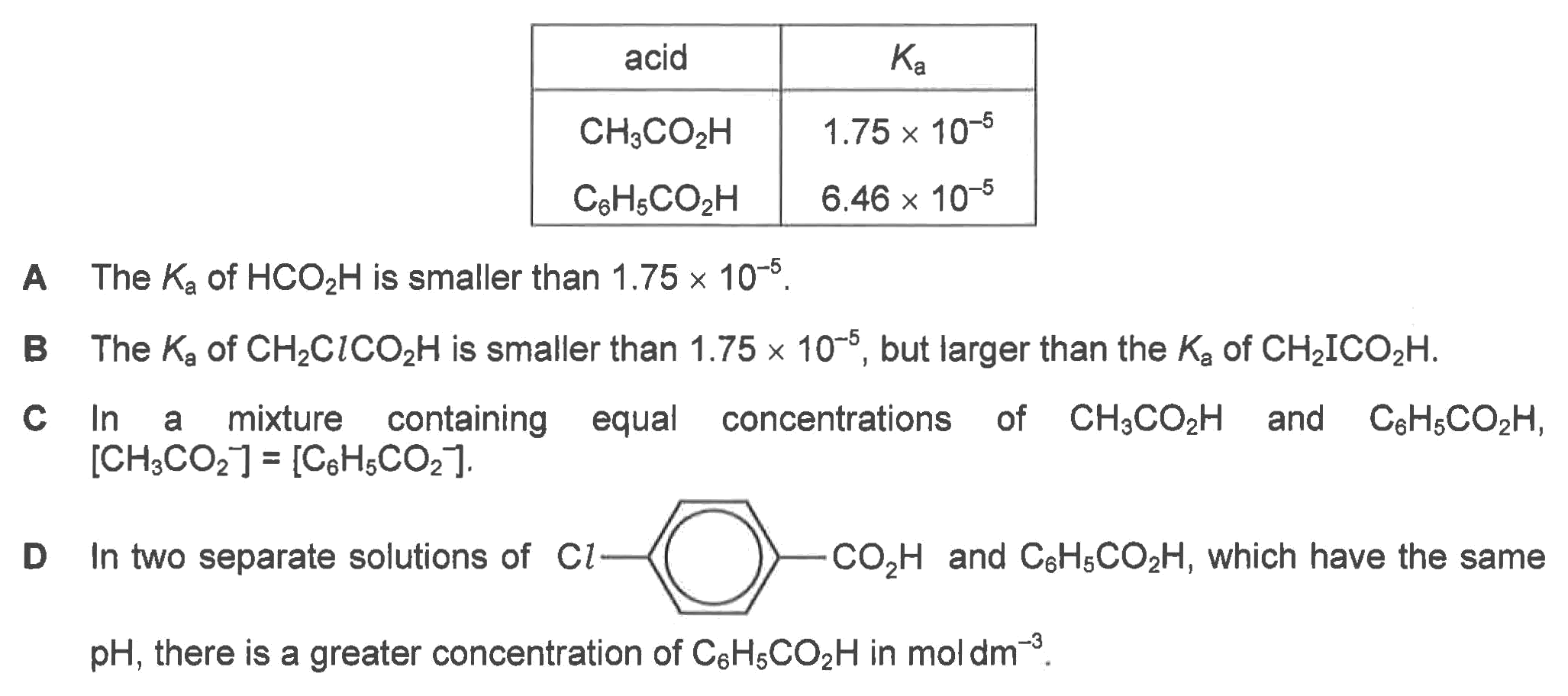
The Cl atom on the ring of 4-chlorobenzoic acid is electron-withdrawing and disperses the negative charge on the carboxylate ion, stabilising the conjugate base. So 4-chlorobenzoic acid is a stronger acid (larger \(K_\text{a}\)) than benzoic acid.
For the two solutions to have the same pH they must have the same \([\text{H}^+]\). The weaker acid, \(\text{C}_6\text{H}_5\text{CO}_2\text{H}\), ionises to a smaller extent, so a greater concentration of \(\text{C}_6\text{H}_5\text{CO}_2\text{H}\) is needed to give the same \([\text{H}^+]\).
• A is wrong: \(\text{HCO}_2\text{H}\) has no electron-donating \(-\text{CH}_3\) group to intensify the negative charge on its conjugate base, so \(\text{HCO}_2^-\) is more stable than \(\text{CH}_3\text{CO}_2^-\) and \(\text{HCO}_2\text{H}\) is the stronger acid, with \(K_\text{a}\) larger than \(1.75 \times 10^{-5}\).
• B is wrong: the electron-withdrawing Cl disperses the negative charge on \(\text{CH}_2\text{ClCO}_2^-\), so \(\text{CH}_2\text{ClCO}_2\text{H}\) is a stronger acid than \(\text{CH}_3\text{CO}_2\text{H}\), with \(K_\text{a}\) larger, not smaller, than \(1.75 \times 10^{-5}\). (The second half is true: Cl is more electronegative than I, so \(\text{CH}_2\text{ClCO}_2\text{H}\) is stronger than \(\text{CH}_2\text{ICO}_2\text{H}\).)
• C is wrong: the two acids have different \(K_\text{a}\) values, so they ionise to different extents. \(\text{C}_6\text{H}_5\text{CO}_2\text{H}\) (\(K_\text{a} = 6.46 \times 10^{-5}\)) is stronger than \(\text{CH}_3\text{CO}_2\text{H}\) (\(1.75 \times 10^{-5}\)), so \([\text{C}_6\text{H}_5\text{CO}_2^-] > [\text{CH}_3\text{CO}_2^-]\).
Want Mr Khemistry to teach you this?
Join a live JC H2 Chemistry class at Bukit Timah, Tampines, or online. Come for a trial lesson, no obligation.
Book a trial classPractice this topic
20+ more Acid base equilibrium questions with shuffled options in ChemBank, free for everyone. Want more? The ChemBank Premium ($100/month) unlocks 4,000+ TYS and Prelim questions, Paper 2 & 3 practice with worked solutions, and all simulations.
Open ChemBank free