2022 H2 Chem P1 Q25 — Carbonyl Compound Solution
Question
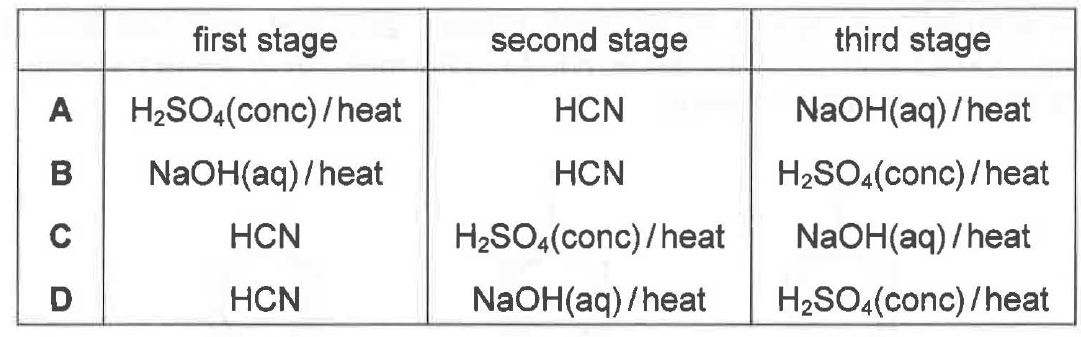
Which reagents could be used for the three stages?
Video Solution
Explanation
The answer is D (HCN, then NaOH(aq)/heat, then \(\text{H}_2\text{SO}_4\)(conc)/heat).
• Stage 1, HCN: nucleophilic addition to the C=O of butanone gives the cyanohydrin \(\text{CH}_3\text{CH}_2\text{C(OH)(CH}_3\text{)CN}\), adding the extra carbon.
• Stage 2, NaOH(aq)/heat: alkaline hydrolysis of the \(-\text{CN}\) group gives the carboxylate salt \(\text{CH}_3\text{CH}_2\text{C(OH)(CH}_3\text{)COO}^-\text{Na}^+\) and \(\text{NH}_3\).
• Stage 3, \(\text{H}_2\text{SO}_4\)(conc)/heat: the acid protonates the carboxylate to give the free \(-\text{COOH}\), and the tertiary \(-\text{OH}\) is eliminated (dehydration) to form the C=C, giving \(\text{CH}_3\text{CH=C(CH}_3\text{)COOH}\).
• A is wrong: butanone has no \(-\text{OH}\) group, so \(\text{H}_2\text{SO}_4\)(conc)/heat cannot eliminate anything in stage 1, and the last stage, NaOH(aq)/heat, would leave a sodium salt rather than the free acid.
• B is wrong: NaOH(aq) in stage 1 does not add the extra carbon to butanone; HCN must be used first to form the cyanohydrin, and after HCN the only remaining stage is \(\text{H}_2\text{SO}_4\)(conc)/heat, which dehydrates the alcohol but does not hydrolyse the \(-\text{CN}\) group, so the product is the nitrile \(\text{CH}_3\text{CH=C(CH}_3\text{)CN}\), not the acid.
• C is wrong: HCN then \(\text{H}_2\text{SO}_4\)(conc)/heat gives \(\text{CH}_3\text{CH=C(CH}_3\text{)CN}\), but the last stage, NaOH(aq)/heat only, hydrolyses the nitrile to the sodium salt, sodium 2-methylbut-2-enoate, not the free acid; there is no acidification stage.
Want Mr Khemistry to teach you this?
Join a live JC H2 Chemistry class at Bukit Timah, Tampines, or online. Come for a trial lesson, no obligation.
Book a trial classPractice this topic
20+ more Carbonyl Compound questions with shuffled options in ChemBank, free for everyone. Want more? The ChemBank Premium ($100/month) unlocks 4,000+ TYS and Prelim questions, Paper 2 & 3 practice with worked solutions, and all simulations.
Open ChemBank free