2022 H2 Chem P1 Q24 — Introduction to Organic Solution
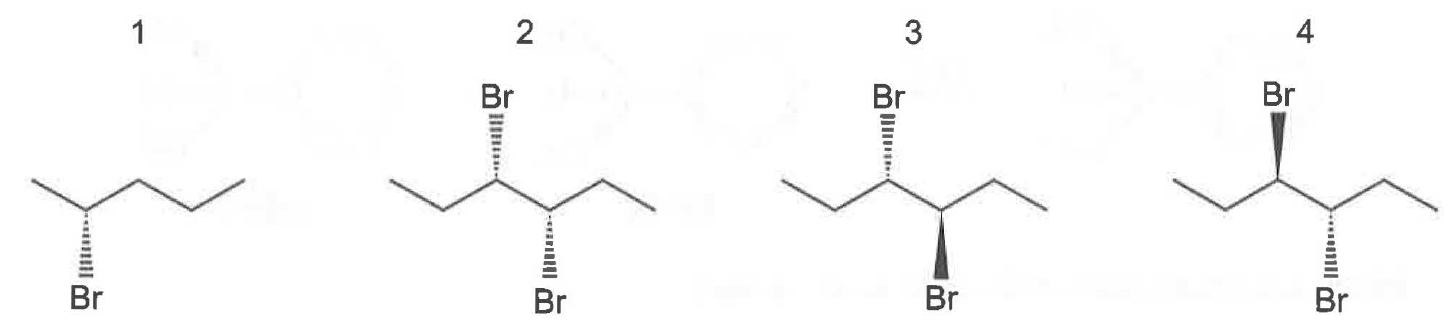
Question
Video Solution
Explanation
The answer is B (1 and 2 only).
A molecule rotates plane-polarised light (is optically active) when it is chiral: it has no plane of symmetry and is not superimposable on its mirror image.
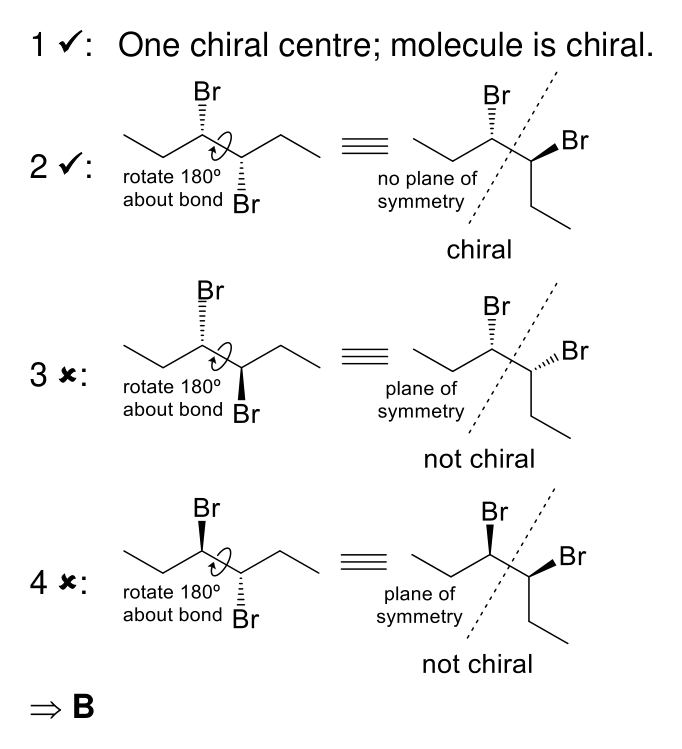
• Molecule 1, 2-bromopentane: it has one chiral centre (C2 bonded to H, Br, \(\text{CH}_3\) and \(\text{CH}_2\text{CH}_2\text{CH}_3\)). A molecule with only one chiral centre is always chiral, so it rotates plane-polarised light.
• Molecule 2, 3,4-dibromohexane with both Br atoms on hashed bonds: after rotating 180° about the C3-C4 bond (explanation figure), there is no plane of symmetry, so it is chiral and rotates plane-polarised light.
• Molecule 3, 3,4-dibromohexane with one Br hashed and one wedged: after rotation there is a plane of symmetry between C3 and C4, so it is a meso compound and does not rotate plane-polarised light.
• Molecule 4, 3,4-dibromohexane with one Br wedged and one hashed: the same meso form as molecule 3, with a plane of symmetry, so it does not rotate plane-polarised light.
• A is wrong: molecules 3 and 4 are meso compounds with a plane of symmetry.
• C is wrong: molecules 3 and 4 are the ones that do not rotate plane-polarised light, while 1 and 2 do.
• D is wrong: molecules 1 and 2 are chiral and do rotate plane-polarised light.
Want Mr Khemistry to teach you this?
Join a live JC H2 Chemistry class at Bukit Timah, Tampines, or online. Come for a trial lesson, no obligation.
Book a trial classPractice this topic
20+ more Introduction to Organic questions with shuffled options in ChemBank, free for everyone. Want more? The ChemBank Premium ($100/month) unlocks 4,000+ TYS and Prelim questions, Paper 2 & 3 practice with worked solutions, and all simulations.
Open ChemBank free