2022 H2 Chem P1 Q23 — Halogenoalkane Solution
Question
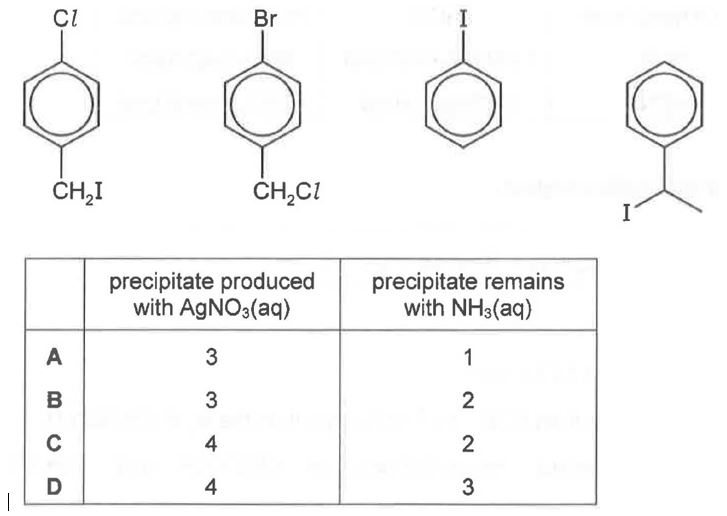
How many mixtures produce precipitates with silver nitrate solution and how many precipitates remain after reaction with ammonia solution?
Video Solution
Explanation
The answer is B.
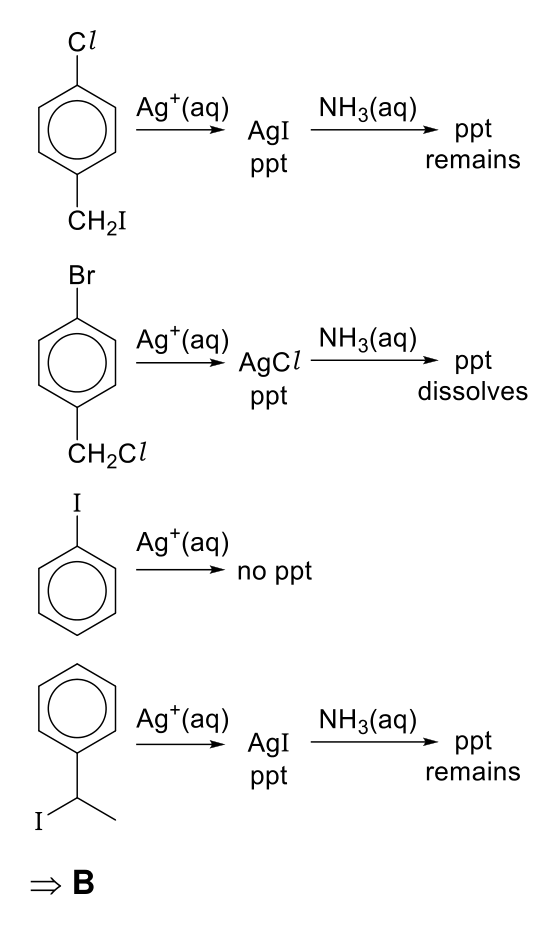
Warming with NaOH releases a halide ion only from a halogen bonded to an alkyl (side-chain) carbon. A halogen bonded directly to the benzene ring is not substituted, because the C-X bond is strengthened by partial double bond character. The released halide then gives a silver halide precipitate with \(\text{AgNO}_3\text{(aq)}\).
• 4-chlorobenzyl iodide, \(\text{ClC}_6\text{H}_4\text{CH}_2\text{I}\): the \(\text{CH}_2\text{I}\) iodine is substituted to give \(\text{I}^-\); the ring Cl is not. AgI precipitate forms, and AgI does not dissolve in aqueous ammonia, so the precipitate remains.
• 4-bromobenzyl chloride, \(\text{BrC}_6\text{H}_4\text{CH}_2\text{Cl}\): the \(\text{CH}_2\text{Cl}\) chlorine is substituted to give \(\text{Cl}^-\); the ring Br is not. AgCl precipitate forms, but AgCl dissolves in aqueous ammonia to give a colourless solution, so no precipitate remains.
• Iodobenzene, \(\text{C}_6\text{H}_5\text{I}\): the I is bonded directly to the ring, so no \(\text{I}^-\) is released and no precipitate forms.
• (1-iodoethyl)benzene, \(\text{C}_6\text{H}_5\text{CH(I)CH}_3\): the side-chain I is released as \(\text{I}^-\) (by substitution and elimination). AgI precipitate forms and remains in aqueous ammonia.
Precipitates with \(\text{AgNO}_3\text{(aq)}\): 3 (AgI, AgCl, AgI). Precipitates remaining with \(\text{NH}_3\text{(aq)}\): 2 (both AgI).
• A is wrong: both AgI precipitates remain in aqueous ammonia, so 2 remain, not 1.
• C and D are wrong: iodobenzene gives no precipitate, so only 3 mixtures give precipitates, not 4.
Want Mr Khemistry to teach you this?
Join a live JC H2 Chemistry class at Bukit Timah, Tampines, or online. Come for a trial lesson, no obligation.
Book a trial classPractice this topic
20+ more Halogenoalkane questions with shuffled options in ChemBank, free for everyone. Want more? The ChemBank Premium ($100/month) unlocks 4,000+ TYS and Prelim questions, Paper 2 & 3 practice with worked solutions, and all simulations.
Open ChemBank free