2022 H2 Chem P1 Q21 — Alkene Solution
Question
What is the structure of X?
Video Solution
Explanation
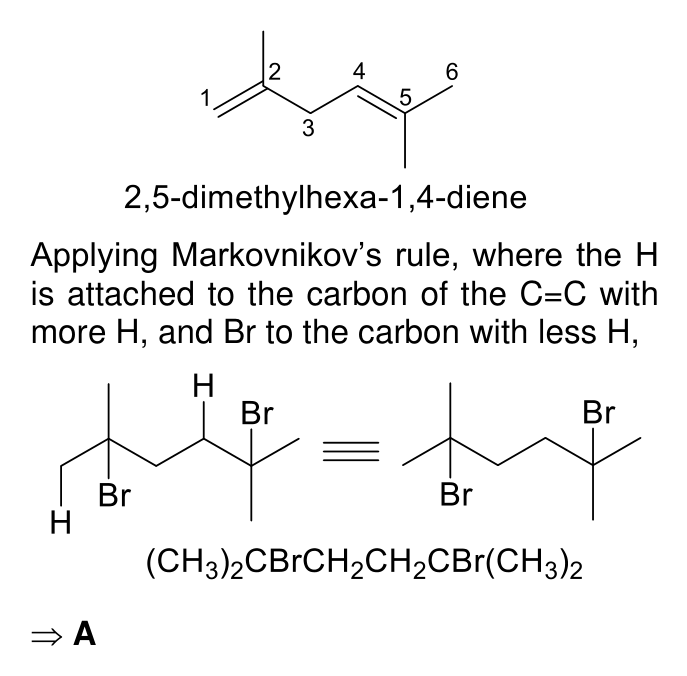
The answer is A (\((\text{CH}_3)_2\text{CBrCH}_2\text{CH}_2\text{CBr(CH}_3)_2\)).
2,5-dimethylhexa-1,4-diene is \(\text{CH}_2\text{=C(CH}_3)\text{CH}_2\text{CH=C(CH}_3)_2\), with C=C bonds between C1 and C2 and between C4 and C5. Both undergo electrophilic addition with HBr.
By Markovnikov's rule, H adds to the C=C carbon with more hydrogen atoms (C1 and C4), and Br adds to the other carbon (C2 and C5), because this goes through the more stable tertiary carbocation at C2 and at C5 (three electron-donating alkyl groups).
Product X: \((\text{CH}_3)_2\text{CBrCH}_2\text{CH}_2\text{CBr(CH}_3)_2\), with both Br atoms on tertiary carbons.
• B is wrong: it puts Br on C4, which needs the less stable secondary carbocation at C4 in the addition to the C4=C5 bond (anti-Markovnikov).
• C is wrong: it puts Br on C1 as \(-\text{CH}_2\text{Br}\), which needs the unstable primary carbocation at C1 in the addition to the C1=C2 bond (anti-Markovnikov).
• D is wrong: both additions are anti-Markovnikov, putting Br on C4 and on C1.
Want Mr Khemistry to teach you this?
Join a live JC H2 Chemistry class at Bukit Timah, Tampines, or online. Come for a trial lesson, no obligation.
Book a trial classPractice this topic
20+ more Alkene questions with shuffled options in ChemBank, free for everyone. Want more? The ChemBank Premium ($100/month) unlocks 4,000+ TYS and Prelim questions, Paper 2 & 3 practice with worked solutions, and all simulations.
Open ChemBank free