2022 H2 Chem P1 Q20 — Introduction to Organic Solution
Question
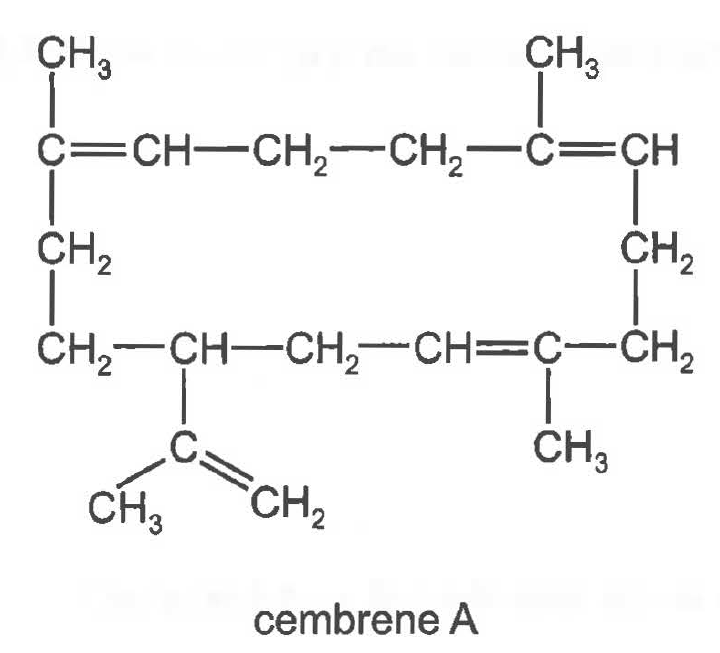
Cembrene A is treated with an excess of hydrogen gas over a platinum catalyst.
How many chiral centres are formed in this reaction?
Video Solution
Explanation
The answer is C (3).
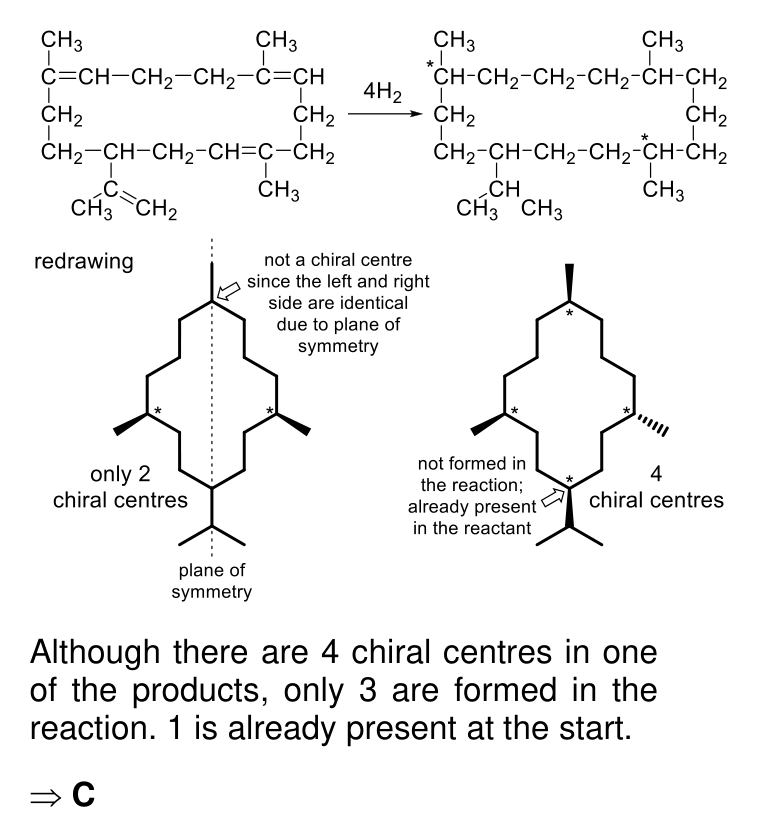
Excess \(\text{H}_2\) over Pt adds to all four C=C bonds (4 mol of \(\text{H}_2\)).
• The three ring C=C bonds each carry a methyl group on one carbon. After hydrogenation each of these carbons becomes \(-\text{CH(CH}_3)-\) in the ring, bonded to H, \(\text{CH}_3\) and two ring branches, and each can become a chiral centre: up to 3 new chiral centres. The other carbon of each ring C=C becomes \(-\text{CH}_2-\), which is not chiral.
• The isopropenyl side group, \(-\text{C(CH}_3)\text{=CH}_2\), becomes isopropyl, \(-\text{CH(CH}_3)_2\). This carbon carries two identical \(\text{CH}_3\) groups, so it is not chiral.
• The ring carbon carrying this side group was already a chiral centre in cembrene A, so it is not formed in the reaction.
As the explanation figure shows, the product with all four chiral centres has only 3 that are formed in the reaction. (In the stereoisomer with a plane of symmetry, two of the ring carbons are not chiral.)
• A is wrong: hydrogenating the three ring C=C bonds turns three ring carbons into \(-\text{CH(CH}_3)-\) chiral centres.
• B is wrong: all three methyl-bearing ring C=C carbons become chiral centres, not just one.
• D is wrong: 4 includes the ring carbon bearing the side group, which was already chiral before the reaction.
Want Mr Khemistry to teach you this?
Join a live JC H2 Chemistry class at Bukit Timah, Tampines, or online. Come for a trial lesson, no obligation.
Book a trial classPractice this topic
20+ more Introduction to Organic questions with shuffled options in ChemBank, free for everyone. Want more? The ChemBank Premium ($100/month) unlocks 4,000+ TYS and Prelim questions, Paper 2 & 3 practice with worked solutions, and all simulations.
Open ChemBank free