2022 H2 Chem P1 Q15 — Solubility Solution
Question
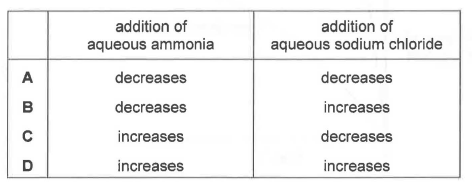
How is the solubility of silver chloride, in this equilibrium mixture, affected by the addition of either
• aqueous ammonia or
• aqueous sodium chloride?
Video Solution
Explanation
The answer is C (ammonia increases the solubility; sodium chloride decreases it).
\(\text{AgCl(s)} \rightleftharpoons \text{Ag}^+\text{(aq)} + \text{Cl}^-\text{(aq)}\)
• Aqueous ammonia: \(\text{NH}_3\) forms the soluble complex \([\text{Ag(NH}_3\text{)}_2]^+\) with \(\text{Ag}^+\), lowering \([\text{Ag}^+]\). The position of equilibrium shifts right, so more AgCl dissolves: solubility increases.
• Aqueous sodium chloride: the common ion \(\text{Cl}^-\) raises \([\text{Cl}^-]\), so the position of equilibrium shifts left and AgCl is precipitated: solubility decreases (common ion effect).
• A is wrong: ammonia increases the solubility, it does not decrease it.
• B is wrong: both entries are reversed; ammonia increases and sodium chloride decreases the solubility.
• D is wrong: sodium chloride decreases the solubility through the common ion effect.
Want Mr Khemistry to teach you this?
Join a live JC H2 Chemistry class at Bukit Timah, Tampines, or online. Come for a trial lesson, no obligation.
Book a trial classPractice this topic
20+ more Solubility questions with shuffled options in ChemBank, free for everyone. Want more? The ChemBank Premium ($100/month) unlocks 4,000+ TYS and Prelim questions, Paper 2 & 3 practice with worked solutions, and all simulations.
Open ChemBank free