2022 H2 Chem P1 Q12 — Kinetics Solution
Question
\(2\text{H}_2\text{O}_2 \rightarrow 2\text{H}_2\text{O} + \text{O}_2\)
Two experiments were performed to study the effects of adding lead(IV) oxide on the decomposition of 1.5 mol dm\(^{-3}\) hydrogen peroxide at constant temperature.
Experiment 1: 20 cm\(^3\) of hydrogen peroxide
Experiment 2: 20 cm\(^3\) of hydrogen peroxide and 1.0 g of lead(IV) oxide
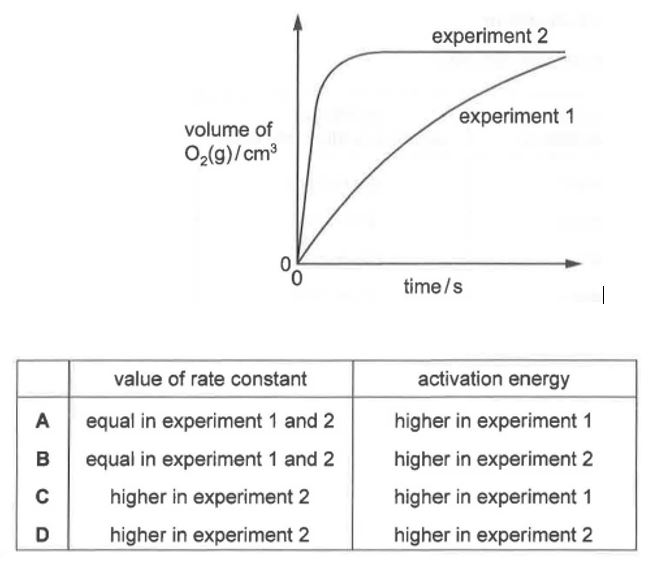
At the end of experiment 2, the mixture was filtered and 1.0 g of lead(IV) oxide was recovered. Which row is correct?
Video Solution
Explanation
The answer is C (rate constant higher in experiment 2; activation energy higher in experiment 1).
The graph shows \(\text{O}_2\) forming much faster in experiment 2, and the 1.0 g of lead(IV) oxide is recovered unchanged, so lead(IV) oxide is a catalyst.
A catalyst provides an alternative pathway with a lower activation energy, so \(E_\text{a}\) is higher in experiment 1 (uncatalysed) than in experiment 2.
The starting concentration of \(\text{H}_2\text{O}_2\) (1.5 mol dm\(^{-3}\)) and the temperature are the same, so the faster rate in experiment 2 means a larger rate constant. This agrees with \(k = Ae^{-E_\text{a}/RT}\): a lower \(E_\text{a}\) gives a larger k.
• A is wrong: the rate constant is not equal; with the same concentration and temperature, a faster rate means a larger k in experiment 2.
• B is wrong: k is not equal, and the activation energy is lower, not higher, in the catalysed experiment 2.
• D is wrong: the catalyst lowers the activation energy, so it is higher in experiment 1, not experiment 2.
Want Mr Khemistry to teach you this?
Join a live JC H2 Chemistry class at Bukit Timah, Tampines, or online. Come for a trial lesson, no obligation.
Book a trial classPractice this topic
20+ more Kinetics questions with shuffled options in ChemBank, free for everyone. Want more? The ChemBank Premium ($100/month) unlocks 4,000+ TYS and Prelim questions, Paper 2 & 3 practice with worked solutions, and all simulations.
Open ChemBank free