2021 H2 Chem P1 Q9 — Periodic table Solution
Question
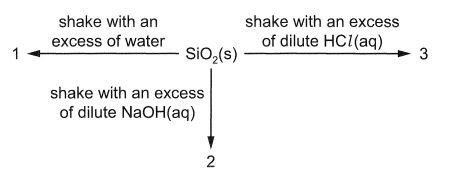
Which observations would the student make of the results of these experiments?
Video Solution
Explanation
The answer is D (solid remains in all three experiments).
\(\text{SiO}_2\) has a giant molecular (giant covalent) structure with strong Si-O covalent bonds throughout, and it is an acidic oxide.
• Experiment 1, water: \(\text{SiO}_2\) is insoluble in water and does not react with it, so the solid remains.
• Experiment 2, dilute NaOH(aq) at room temperature: although \(\text{SiO}_2\) is acidic, it reacts with NaOH only when heated with concentrated NaOH(aq) (to form \(\text{Na}_2\text{SiO}_3\)). With dilute NaOH(aq) at room temperature no reaction occurs, so the solid remains.
• Experiment 3, dilute HCl(aq): \(\text{SiO}_2\) is an acidic oxide and does not react with acids, so the solid remains.
• A is wrong: \(\text{SiO}_2\) does not dissolve in any of the three; it is insoluble in water, unreactive towards dilute acid and needs hot concentrated alkali to react.
• B is wrong: a solid remains in all three experiments, not just one.
• C is wrong: this would need \(\text{SiO}_2\) to dissolve in one of the reagents, for example dilute NaOH(aq), but it does not react with dilute NaOH(aq) at room temperature.
Want Mr Khemistry to teach you this?
Join a live JC H2 Chemistry class at Bukit Timah, Tampines, or online. Come for a trial lesson, no obligation.
Book a trial classPractice this topic
20+ more Periodic table questions with shuffled options in ChemBank, free for everyone. Want more? The ChemBank Premium ($100/month) unlocks 4,000+ TYS and Prelim questions, Paper 2 & 3 practice with worked solutions, and all simulations.
Open ChemBank free