2021 H2 Chem P1 Q5 — Chemical bonding Solution
Question
Video Solution
Explanation
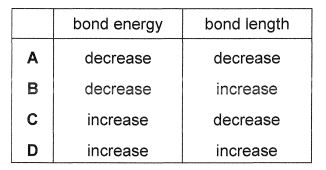
The answer is C (bond energy increases, bond length decreases).
The carbon to carbon bond changes from a single bond in \(\text{H}_3\text{C-CH}_3\), to a double bond in \(\text{H}_2\text{C=CH}_2\), to a triple bond in \(\text{HC}\equiv\text{CH}\).
More shared pairs of electrons between the two carbon nuclei give a stronger attraction, so the bond is stronger and the nuclei are pulled closer together.
Data Booklet values:
• bond energy: C-C 350, C=C 610, C\(\equiv\)C 840 kJ mol\(^{-1}\), so the bond energy increases.
• bond length: C-C 0.154, C=C 0.134, C\(\equiv\)C 0.120 nm, so the bond length decreases.
• A is wrong: the bond length does decrease, but the bond energy increases (350 to 610 to 840 kJ mol\(^{-1}\)), it does not decrease.
• B is wrong: both trends are reversed; the bond energy increases and the bond length decreases.
• D is wrong: the bond energy does increase, but the bond length decreases (0.154 to 0.134 to 0.120 nm), it does not increase.
Want Mr Khemistry to teach you this?
Join a live JC H2 Chemistry class at Bukit Timah, Tampines, or online. Come for a trial lesson, no obligation.
Book a trial classPractice this topic
20+ more Chemical bonding questions with shuffled options in ChemBank, free for everyone. Want more? The ChemBank Premium ($100/month) unlocks 4,000+ TYS and Prelim questions, Paper 2 & 3 practice with worked solutions, and all simulations.
Open ChemBank free