2021 H2 Chem P1 Q4 — Atomic structure Solution
Question
Which element has the highest first ionisation energy?
Video Solution
Explanation
The answer is B (X).
A big jump in successive ionisation energies shows that the next electron is removed from an inner shell, closer to the nucleus.
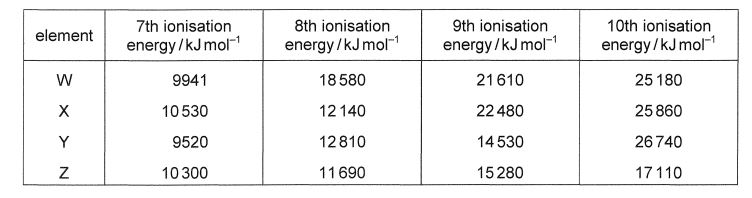
• W: big jump between the 7th and 8th ionisation energies (9941 to 18 580 kJ mol\(^{-1}\)), so W has 7 outer electrons: Group 17.
• X: big jump between the 8th and 9th (12 140 to 22 480 kJ mol\(^{-1}\)), so X has 8 outer electrons: Group 18.
• Y: big jump between the 9th and 10th (14 530 to 26 740 kJ mol\(^{-1}\)): 1 electron in a new outer shell plus the 8 electrons of the shell below, so Y is in Group 1 of the next period.
• Z: the next element, Group 2 of the next period.
The first ionisation energy of Y and Z is lower than that of W and X, because the outermost electron of Y and Z is in a new quantum shell, further from the nucleus and shielded by one extra shell of inner electrons.
Between W and X, the electron removed is in the same shell with similar shielding, but X has one more proton, so the nuclear charge is higher and X has the higher first ionisation energy. X, the noble gas, has the highest first ionisation energy.
• A is wrong: W (Group 17) has one proton fewer than X with the same shielding, so its first ionisation energy is lower than that of X.
• C is wrong: Y (Group 1) loses an electron from a new shell, further from the nucleus and more shielded, so it has the lowest first ionisation energy of the four.
• D is wrong: Z (Group 2) also loses an electron from the new shell, so its first ionisation energy is much lower than that of X.
Want Mr Khemistry to teach you this?
Join a live JC H2 Chemistry class at Bukit Timah, Tampines, or online. Come for a trial lesson, no obligation.
Book a trial classPractice this topic
20+ more Atomic structure questions with shuffled options in ChemBank, free for everyone. Want more? The ChemBank Premium ($100/month) unlocks 4,000+ TYS and Prelim questions, Paper 2 & 3 practice with worked solutions, and all simulations.
Open ChemBank free