2021 H2 Chem P1 Q3 — Atomic structure Solution
Question
Which statement about these ionisation energies is correct?
Video Solution
Explanation
The answer is C.
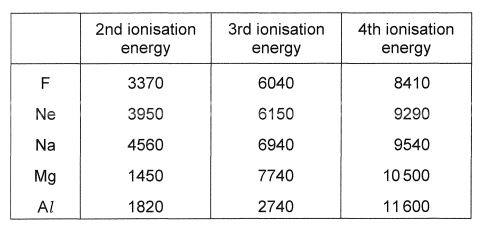
C ✓: The 4th ionisation energy of Na removes an electron from \({}_{11}\text{Na}^{3+}\) : [He] \(2s^2\) \(2p^4\). The 3rd ionisation energy of Ne removes an electron from \({}_{10}\text{Ne}^{2+}\) : [He] \(2s^2\) \(2p^4\). Both ions have the same electronic configuration, so shielding is similar, but the nuclear charge of Na (11) is higher than that of Ne (10). The 2p electron in \(\text{Na}^{3+}\) experiences a higher effective nuclear charge, so 9540 > 6150 kJ mol\(^{-1}\).
A ✗: The comparison is true (3370 > 2740 kJ mol\(^{-1}\)) but the reason is wrong. \({}_9\text{F}^+\) : [He] \(2s^2\) \(2p^4\) has 6 outer shell electrons, while \({}_{13}\text{Al}^{2+}\) : [Ne] \(3s^1\) has only 1, so \(\text{Al}^{2+}\) has fewer outer shell electrons, not more. The real reason: despite Al having a higher nuclear charge than F, \(\text{Al}^{2+}\) has 10 core electrons shielding its 3s electron while \(\text{F}^+\) has only 2 core electrons, and the 2p electron is in a shell closer to the nucleus. Hence the effective nuclear charge experienced by the 2p electron in \(\text{F}^+\) is higher than that experienced by the 3s electron in \(\text{Al}^{2+}\).
B ✗: The 3rd ionisation energy removes an electron from the 2+ ion:
• \(\text{F}^{2+}\) : [He] \(2s^2\) \(2p^3\)
• \(\text{Ne}^{2+}\) : [He] \(2s^2\) \(2p^4\)
• \(\text{Na}^{2+}\) : [He] \(2s^2\) \(2p^5\)
• \(\text{Mg}^{2+}\) : [He] \(2s^2\) \(2p^6\)
• \(\text{Al}^{2+}\) : [Ne] \(3s^1\)
The 3rd ionisation energy of Al removes a 3s electron (third shell), while the rest remove a 2p electron (second shell).
D ✗: The successive ionisation energies do increase, but the electrons are not all taken from the same shell. The big jump between the 2nd and 3rd ionisation energies of Mg (1450 to 7740 kJ mol\(^{-1}\)) and between the 3rd and 4th ionisation energies of Al (2740 to 11600 kJ mol\(^{-1}\)) shows that the later electron is removed from a different, inner shell.
Want Mr Khemistry to teach you this?
Join a live JC H2 Chemistry class at Bukit Timah, Tampines, or online. Come for a trial lesson, no obligation.
Book a trial classPractice this topic
20+ more Atomic structure questions with shuffled options in ChemBank, free for everyone. Want more? The ChemBank Premium ($100/month) unlocks 4,000+ TYS and Prelim questions, Paper 2 & 3 practice with worked solutions, and all simulations.
Open ChemBank free