2021 H2 Chem P1 Q24 — Acid base equilibrium Solution
Question
\(\text{H}_3\text{N}^+-\text{CH}_2-\text{CO}_2\text{H} \rightleftharpoons \text{H}_3\text{N}^+-\text{CH}_2-\text{CO}_2^- + \text{H}^+\) \(pK_a(1)\)
\(\text{H}_3\text{N}^+-\text{CH}_2-\text{CO}_2^- \rightleftharpoons \text{H}_2\text{N}-\text{CH}_2-\text{CO}_2^- + \text{H}^+\) \(pK_a(2)\)
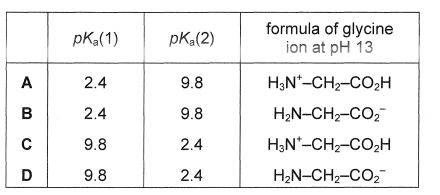
Which row could be correct?
Video Solution
Explanation
The answer is B (\(pK_a(1)\) = 2.4, \(pK_a(2)\) = 9.8, \(\text{H}_2\text{N-CH}_2\text{-CO}_2^-\) at pH 13).
\(pK_a(1) < pK_a(2)\):
• the \(-\text{CO}_2\text{H}\) group is a much stronger acid than the \(-\text{NH}_3^+\) group, so it loses \(\text{H}^+\) first;
• it is also harder to remove \(\text{H}^+\) from a species that already carries a negative charge (the zwitterion) than from the cation.
So \(pK_a(1)\) = 2.4 and \(pK_a(2)\) = 9.8.
pH 13 is well above \(pK_a(2)\) = 9.8, so the second dissociation equilibrium lies far to the right and \(\text{H}_2\text{N-CH}_2\text{-CO}_2^-\) is the predominant species.
• A is wrong: the \(pK_a\) values are right, but \(\text{H}_3\text{N}^+\text{-CH}_2\text{-CO}_2\text{H}\) is the predominant species only below pH 2.4, in strongly acidic solution, not at pH 13.
• C is wrong: the \(pK_a\) values are swapped (the \(-\text{CO}_2\text{H}\) group is the more acidic, so \(pK_a(1)\) is the smaller value), and the cation is not present at pH 13.
• D is wrong: the species at pH 13 is right, but the \(pK_a\) values are swapped; \(pK_a(1)\) must be smaller than \(pK_a(2)\).
Want Mr Khemistry to teach you this?
Join a live JC H2 Chemistry class at Bukit Timah, Tampines, or online. Come for a trial lesson, no obligation.
Book a trial classPractice this topic
20+ more Acid base equilibrium questions with shuffled options in ChemBank, free for everyone. Want more? The ChemBank Premium ($100/month) unlocks 4,000+ TYS and Prelim questions, Paper 2 & 3 practice with worked solutions, and all simulations.
Open ChemBank free