2021 H2 Chem P1 Q23 — Nitrogen Compound Solution
Question
Compound X also reacts with warm \(\text{HCl(aq)}\) to form a salt with formula \(\text{C}_6\text{H}_{14}\text{NO}_2\text{Cl}\).
What could be the identity of X?
Video Solution
Explanation
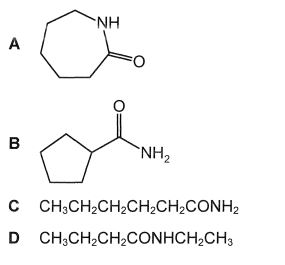
The answer is A (the cyclic amide, azepan-2-one).
\(\text{LiAlH}_4\) reduces an amide C=O group to \(\text{CH}_2\), so X has one more O and two fewer H than the product \(\text{C}_6\text{H}_{13}\text{N}\): X is \(\text{C}_6\text{H}_{11}\text{NO}\).
Warm HCl(aq) hydrolyses the amide. The salt \(\text{C}_6\text{H}_{14}\text{NO}_2\text{Cl}\) keeps all 6 C atoms and the N atom, so the \(-\text{NH}_3^+\) and \(-\text{CO}_2\text{H}\) must end up in the same product. X must be a cyclic amide.
For A (\(\text{C}_6\text{H}_{11}\text{NO}\)):
• with \(\text{LiAlH}_4\): the ring C=O becomes \(\text{CH}_2\), giving the cyclic amine azepane, \(\text{C}_6\text{H}_{13}\text{N}\).
• with warm HCl(aq): the ring opens to give \(\text{Cl}^-\,\text{H}_3\text{N}^+\text{CH}_2\text{CH}_2\text{CH}_2\text{CH}_2\text{CH}_2\text{CO}_2\text{H}\), which is \(\text{C}_6\text{H}_{14}\text{NO}_2\text{Cl}\).
Both formulae match.
• B is wrong: it is \(\text{C}_6\text{H}_{11}\text{NO}\) and \(\text{LiAlH}_4\) gives cyclopentylmethylamine, \(\text{C}_6\text{H}_{13}\text{N}\), but hydrolysis with HCl(aq) splits off the N as \(\text{NH}_4\text{Cl}\) and leaves cyclopentanecarboxylic acid, \(\text{C}_6\text{H}_{10}\text{O}_2\). No salt \(\text{C}_6\text{H}_{14}\text{NO}_2\text{Cl}\) forms.
• C is wrong: hexanamide is \(\text{C}_6\text{H}_{13}\text{NO}\); \(\text{LiAlH}_4\) gives hexylamine, \(\text{C}_6\text{H}_{15}\text{N}\), not \(\text{C}_6\text{H}_{13}\text{N}\), and hydrolysis gives hexanoic acid and \(\text{NH}_4\text{Cl}\).
• D is wrong: N-ethylbutanamide is \(\text{C}_6\text{H}_{13}\text{NO}\); \(\text{LiAlH}_4\) gives \(\text{CH}_3\text{CH}_2\text{CH}_2\text{CH}_2\text{NHCH}_2\text{CH}_3\), \(\text{C}_6\text{H}_{15}\text{N}\), and hydrolysis splits it into butanoic acid and ethylammonium chloride, \(\text{C}_2\text{H}_5\text{NH}_3^+\text{Cl}^-\), so no single salt with 6 C atoms forms.
Want Mr Khemistry to teach you this?
Join a live JC H2 Chemistry class at Bukit Timah, Tampines, or online. Come for a trial lesson, no obligation.
Book a trial classPractice this topic
20+ more Nitrogen Compound questions with shuffled options in ChemBank, free for everyone. Want more? The ChemBank Premium ($100/month) unlocks 4,000+ TYS and Prelim questions, Paper 2 & 3 practice with worked solutions, and all simulations.
Open ChemBank free